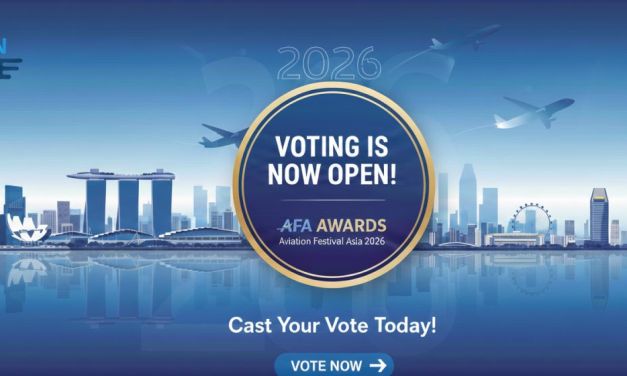
Aviation Festival Asia Award 2026 nominations are now open!

Aviation Festival Asia Award 2026 nominations are now open!

The aviation industry in Asia is moving faster than ever, driven by cutting-edge technology, bold collaborations, and a deep commitment to sustainable growth. The Aviation Festival Asia Awards 2026 are here to celebrate the organisations and initiatives that are redefining what’s possible in the region.

We invite you to recognise the organisations that have truly excelled this year across operations, customer experience, and digital transformation.

Award Categories

  • Sustainability Achievement Award: Recognizing outstanding commitment to environmental responsibility and sustainable practices in aviation.
  • Best Use of AI: Honouring exceptional application of artificial intelligence to improve operations, efficiency, or passenger experience.
  • Collaboration of the Year (Airline/airport/ground handlers only): Celebrating a successful partnership between airlines or between an airline and an airport that delivered measurable innovation or impact.
  • Industry Game-Changer: Awarded to an airline that has redefined norms, challenged conventions, and driven transformative change within the industry.
  • Smart Airport Journey Award: Recognizing an airport that has significantly enhanced the passenger journey through innovative technology solutions.
  • Digital Innovator of the Year: Awarded to a company, team, or initiative that demonstrated visionary use of digital tools or platforms to reshape airline or airport operations, customer experience, or service delivery.

Submit your nominations here!

Key Submission Details

Submissions are based on individual organisations and their groundbreaking achievements. While the award is for the company/organisation, we encourage you to mention individual people or teams in your submission if it helps illustrate the achievement; this will help us in reaching out to potential finalists.

The deadline for all submissions is Monday, Jan 19th.

Please note: To officially accept and receive an award at the ceremony during Aviation Festival Asia (March 25 – 26, 2026, Singapore), a representative from the winning organisation must be registered to attend the event

Submit your nominations here!

We can’t wait to recognise the achievements of the industry in Singapore!

Our Battle of the Airline Apps Asia competition is also open for submissions. This separate award honours the best in airline technology, customer service, and operational excellence. Be sure to vote for your favourite today!

Elon Musk swipes at American Airlines over Amazon Leo talks

Elon Musk swipes at American Airlines over Amazon Leo talks

Elon Musk and Space X’s VP for Starlink Engineering have disparaged American Airlines on X as the airline entered talks for a potential inflight connectivity deal with rivals Amazon Leo.

Bloomberg first reported that American were discussing a partnership with Amazon last week. Formerly known as Project Kuiper, Amazon Leo has launched 150 low-earth orbit (LEO) satellites, putting it directly in competition with the Starlink project.

Seemingly taking a swipe at the potential Amazon/American partnership, SpaceX VP for Starlink Engineering Michael Nicolls posted on X:

Only fly on airlines with good connectivity… and only one source of good connectivity at the moment…

Elon Musk, SpaceX founder and CEO, added fuel to the flames, replying to Nicholls’ post:

American Airlines will lose a lot of customers if their connectivity solution fails

Starlink’s LEO coverage far surpasses that of its competitors. With a constellation of 9,000 satellites, the company already provides internet access to more than 8 million users worldwide. So far, JetBlue are the only airline to have signed a deal with Amazon LEO for inflight WiFi, while Starlink boasts an impressive roster of aviation partners, including IAG, Qatar Airways, and United.

American Airlines currently partners with Viasat to offer inflight WiFi to passengers. Internet access comes at a fee of US$10 or more, but subscription plans are available for frequent flyers. Airlines such as Emirates, which have gained a reputation for industry-leading customer service, say Starlink WiFi will be available for free to all passengers once installation is complete. As American doubles down on its premiumisation strategy, improving inflight connectivity could be a key market differentiator.

Join us at Aviation Festival Americas 2026 to discuss the future of inflight of connectivity.

For more like this, see:

The key principles for effective AI adoption in aviation

The key principles for effective AI adoption in aviation

Executing an effective AI strategy in an industry constructed on legacy systems is no small challenge. But as airlines and airports begin the complex modernisation process, robust frameworks will make all the difference.

Kumar Paramasivam, Senior Vice President at Infosys, shared his advice for the aviation industry in an exclusive interview at World Aviation Festival 2025. With AI constantly being mentioned in the news at an conferences, the tech is at risk of being reduced to a buzzword. Paramasivam offers holistic advice to airlines and airports beginning their journey:

You should also look at areas where you have rich data, where you have historical data, and data that is contextual, real time. That provides the required fuel for AI to produce its results.

In just a year, the conversation around AI has shifted from generative to agentic AI. In this extremely fast-moving field, it can be hard to keep up with, let alone predict, change. Yet data privacy and regulatory compliance must remain the ultimate priority when implementing new tech.

We have to make sure that there’s explainability: these are the data points that were collected, this is how it was used, and making sure that it is secure. 

Paramasivam concludes by offering a fundamental rule for AI integration:

We use something called value realisation methodology, which means every change that you’re making is seen through a lens of improving customer experience, improving revenues, bringing down your cost. If you apply these lenses and make sure that the metrics tied to the program are connected to these then it leads to success.

🎥 Watch the interview to hear the full discussion on AI in aviation

Questions asked include:

  • Everyone’s talking about AI, but how can airlines and airports pick use cases that offer real longevity and value?
  • What about agentic AI? Have you seen any good use cases that actually deploys the full potential of this technology?
  • What kind of practices does the aviation industry need to have in place to maintain consumer trust and protect sensitive information, especially as personalisation becomes more prevalent?
  • What advice would you give to airlines and airports beginning their digital journey?

Join us at World Aviation Festival 2026 to explore the future of AI integration in aviation.

For more like this, see:

Riyadh Air partner with Huawei to enhance their digital ecosystem

Riyadh Air partner with Huawei to enhance their digital ecosystem

Riyadh Air, Saudi Arabia’s new national carrier, have signed a Memorandum of Understanding (MoU) with Chinese tech company Huawei.

The partnership will leverage Huawei technology across the airline’s digital ecosystem to optimise the passenger experience, including through the Cloud and AI. Additionally, over 20% of Chinese citizens use Huawei smartphones, representing a significant opportunity for Riyadh Air to tailor their services to Chinese customers.

Vincent Coste, Chief Commercial Officer of Riyadh Air, said:

The Chinese market is an important part of Riyadh Air’s global expansion and essential to Saudi Arabia’s tourism growth.

As the Kingdom raises its target to 150 million tourists by 2030, our partnership with Huawei strengthens our ability to deliver the digital, seamless and personalised journey Chinese guests travellers expect.

Riyadh Air will begin commercial service in 2026. Aiming to serve 100 destinations worldwide by 2030, the airline is critical to Saudi Arabia’s economic diversification strategy. According to IATA, Asia-Pacific remains the fastest-growing region for air travel, and China forms a critical piece of this puzzle. Coste has asserted that Riyadh Air will improve connectivity between the two countries.

Peak Yin, CEO KSA, HUAWEI Consumer Business Group (CBG) said:

We have found a true partner in Riyadh Air, a digital-native, future-focused national carrier. Huawei is committed to supporting Riyadh Air with our best global technologies to co-create world-class digital experiences for travellers from China – and around the world.

This partnership is designed as a seamless and continuously evolving collaboration, enabling us to innovate together, elevating every stage of the travel experience and pushing the boundaries of what technology can bring to the aviation industry – and its guests.

Huawei joins Riyadh Air’s growing list of technology partners, including IBM, FLYR, and Loyalty Juggernaut. The carrier aspires to become the world’s first ‘digital-native’ airline, unencumbered by legacy infrastructure.

Join us at Aviation Festival Asia 2026 to experience the intersection of aviation and technology.

For more like this, see:

The most important aviation trends to watch in 2026

The most important aviation trends to watch in 2026

It’s that time of the year again, where experts across the industry get out their crystal balls and try to predict the next game-changing developments in travel and aviation. To celebrate the imminent arrival of 2026, we’ve compiled a shortlist of the biggest trends, as forecasted by some of the world’s leading publications and brands.

Amadeus: Pet-friendly travel and innovation tourism

In partnership with Globetrender, Amadeus listed seven key trends that they think will have an impact in 2026. This includes an expansion in pet-friendly travel, as passengers become enthusiastic to bring their canine companions (and maybe even a grumpy cat) on their holidays.

Innovation tourism was highlighted as another potential theme: with the launch of autonomous taxis in the US and assistant robots in China, people are keener than ever to experience the future with their own eyes. Amadeus also noted the growing volume of narrow-body jets. The A321XLR could be transformative in long-haul, connecting destinations across continents that might otherwise only be served by short-haul flights.

Skift: Vibe coding and air taxis

In their Megatrends 2026 report, Skift foresee that the luxury bubble will only grow, but warns of the potential danger if this pops. Other trends they say to watch out for include the shift to AI search, which directly threaten online travel agents (OTAs), and unrealistic sustainability targets.

Skift name vibe coding as another huge shift that could unlock a new generation of travel startups. Meanwhile, they say that the potential debut of air taxis in 2026, as well as more partnerships with the rail industry, will revolutionise intermodal connectivity in travel.

Forbes: Luxury escapes in Asia 

Forbes limited its predictions to the luxury travel sector, but also highlighted the growing popularity of train and boat travel. The expansion of cruise liners and the Orient Express brand underlines the demand for heritage travel, representing a significant opportunity for airline partnerships. The FIFA World Cup 2026 will also be a huge test for American airlines, airports, and air traffic control, with around 5 million extra visitors expected over the summer.

Asian destinations will remain at the top of the premium travel pile, Forbes says, especially as the Michelin Guide launches new editions for countries such as the Philippines.

BBC: AI admin and ultra-personalisation

BBC Travel’s trends roundup highlighted interesting developments such as culture tourism and the emergence of unplugged, digital-free ‘quietcations’,

But two points they note that will undoubtedly be transforming the aviation industry in 2026 are AI admin and ultra-personalisation. Travellers are increasingly using large-language models such as ChatGPT to plan their trips for them, which requires a real digital strategy rethink for airlines. Customers can even use AI to find niche trips and destinations that cater to all their interests, such as marriage retreats and sports holidays. As personalised experiences become the norm, the aviation industry will need to find ways to integrate personalisation into their offering to create a holistic travel experience.

Join us at World Aviation Festival 2026 to discuss the biggest industry trends.

For more like this, see:

Tech and innovation keep Dallas Fort Worth at the top

Tech and innovation keep Dallas Fort Worth at the top

Handling 87 million passengers every year, Dallas Fort Worth International (DFW) is the third-busiest airport in the world. At the same time, for three consecutive years, Airports Council International (ACI) has recognised DFW as one of the best large airports in North America. So how does the Texan airport achieve its high customer service scores while processing such huge traveller numbers?

Paul Puopolo, DFW’s Chief Technology and Innovation Officer, believes tech investment has been instrumental to improving airport processes and enhancing the traveller experience.

We began our innovation journey about six years ago, and one of the things that we did was we looked at customer needs. On the innovation side, our team really tries to take a human-centric approach.

Among the security measures Puopolo has overseen are streamlined security, a private 5G network, biometrics, and artificial intelligence (AI) systems. DFW’s new Terminal F, currently in construction, also represents an opportunity to rethink airport design. When complete, the US$1.6 billion project will boast self-service bag drops, e-gates, and sensors for managing passenger flow.

When we build new infrastructure, we want to make sure it’s a little bit more flexible. So as customer needs change, we can change. We don’t want to end up being like a mall that nobody goes to anymore.

Advanced air mobility (AAM) is one such consideration. A ‘when, not if’ evolution for the industry, Puopolo is watching sandbox initiatives in the Middle East to see how eVTOLs and air taxis could be incorporated at DFW once they receive FAA certification. He currently forecasts that AAM services could go live in 2028, but for this to be possible DFW needs to prepare now.

We believe air taxis are coming to the airport, and being a feeder route is important to us. But for that to happen, we have to make our infrastructure investments two to three years ahead.

🎥 Watch the interview to hear Paul Puopolo’s full thoughts on AAM integration, tech, and innovation.

Questions asked include:

  • What role do you think innovation has played in boosting your customer service rating?
  • What are your plans for Terminal F from a tech perspective?
  • How can airports implement designs that are tech-forward but also sustainable and long-lasting?
  • How do you see air taxis being integrated at DFW in the future?

Join us at Aviation Festival Americas 2026 to discuss the future of airport technology in the region.

For more like this, see:

Flair Airlines debuts North America’s first ticket resale platform

Flair Airlines debuts North America’s first ticket resale platform

Canadian low-cost carrier (LCC) Flair Airlines is set to launch a ticket resale service, the first of its kind in North American aviation.

The platform is powered by French startup Fairlyne, who already partner with Royal Air Maroc and Transavia on similar services. Through their technology, passengers holding non-refundable tickets can sell them to another passenger and receive a Flair voucher in exchange.

Maciej Wilk, CEO of Flair Airlines, said:

This service is about giving passengers a better experience — even when they can’t travel. It’s a smart solution that offers more flexibility while optimising our operations.

The initiative is part of the LCC’s Flair FWD strategy, which aims to strengthen Flair’s position in the Canadian market while consolidating its reputation for fair, fuss-free travel. Other strategies launched under the Flair FWD banner include AI-enhanced omnichannel customer communications, and the package holiday service Flair Vacations.

Presenting the project as a ‘win-win’ for passengers and the airline, the resale platform will launch in the coming weeks. Gilles de Richemond, CEO of Fairlyne, commented:

We’re helping airlines introduce a new level of customer service and flexibility, while maintaining complete control. It’s a customer-first approach that addresses a long-standing frustration.

Join us at Aviation Festival Americas 2026, where Flair CEO Maciej Wilk will be on-stage for an exclusive keynote interview and CEO panel.

For more like this, see:

SAF production rate to slow, complicating airline sustainability plans

SAF production rate to slow, complicating airline sustainability plans

This article was originally published on our sister site, Aerospace Tech Review

IATA has published its latest sustainable aviation fuel (SAF) production figures and issued a stark warning as the industry looks set to miss key targets.

SAF production has doubled from 2024, reaching 1.9 million tonnes (Mt) by the end of 2025, according to IATA. However, these numbers full short of earlier forecasts, and in 2026 the production rate is projected to slow and reach only 2.4Mt.

IATA lists policies in Europe, including the EU’s ReFuelEU Aviation and UK SAF mandates, as key hindrances. They say these schemes have pushed high SAF costs onto airlines and fail to nurture a stable supply chain. In a strongly-worded statement, Director General Willie Walsh emphasised the urgency of change:

SAF production growth fell short of expectations as poorly designed mandates stalled momentum in the fledgling SAF industry. If the goal of SAF mandates was to slow progress and increase prices, policymakers knocked it out of the park. But if the objective is to increase SAF production to further the decarbonisation of aviation, then they need to learn from failure and work with the airline industry to design incentives that will work.

Marie Owens Thomsen, IATA’s Senior Vice President for Sustainability and Chief Economist, said it would be ‘outrageous’ if regulators were to take the same approach with forthcoming e-SAF mandates. e-SAF already suffers from a much-higher cost base than conventional SAF due to the costs of renewable energy supplies. 

Regardless, IATA say the failures of SAF so far have already complicated sustainability targets. Walsh adds:

Regrettably, many airlines that have committed to use 10% SAF by 2030 will be forced to reevaluate these commitments. SAF is not being produced in sufficient amounts to enable these airlines to achieve their ambition. These commitments were made in good faith but simply cannot be delivered.

Join us at Aerospace Tech Week 2026 to discuss the future of sustainable aviation. 

For more like this, see:

Air Serbia banks on AI to transform its loyalty programme

Air Serbia banks on AI to transform its loyalty programme

Air Serbia has partnered with Loyalty Juggernaut to overhaul its loyalty programme.

The Serbian national carrier has set March 2026 as the launch data for its revamped loyalty offering. Loyalty Juggernaut’s AI-powered Gravty platform will provide the infrastructure to maximise customer engagement. Snezana Radinovic, Frequent Flyer Product Development Manager at Air Serbia, said:

Our ambition is to create one of the most engaging loyalty propositions in Europe.

Specific details of the scheme, such as rewards and partners, are currently unknown. Loyalty Juggernaut’s technology underpins many airlines’ cutting-edge loyalty offerings, including Emirates Skywards and new airline Riyadh Air’s Sfeer. Based on these examples, Air Serbia frequent flyers can expect to benefit from personalised offers and upgrades, as well as the opportunity to spend points on ancillaries such as car rental and hotels.

Jiří Marek, CEO of Air Serbia, added:

This partnership marks a key step in transforming how we engage with passengers. We are building a modern loyalty ecosystem that rewards customers for every interaction with Air Serbia. By combining our service excellence with LJ’s technology, we will deliver a program that reflects today’s travellers: connected, mobile, and seeking personalised value.

Air Serbia will celebrate 100 years of operations in 2027, and the carrier has set an ambitious new strategy to mark its centenary. Carrying 4.4 million passengers a year, the airline has added 50 new destinations in the past four years, including launching a new long-haul route to Toronto. Marek has described an airline as ‘a natural ambassador of its home country’. Through its partnership with Loyalty Juggernaut, Air Serbia will hope to strengthen its image and boost connectivity to the Balkans.

Join us at World Aviation Festival 2026 to discuss the evolution of loyalty programmes.

For more like this, see:

Airlines to profit by $41 billion in 2026, though profit margins unchanged

Airlines to profit by $41 billion in 2026, though profit margins unchanged

IATA have released its financial forecasts for airlines in 2026, predicting that the industry will bring in a record US$41 billion in profits.

2025 profits are currently predicted in the region of US$39.5 billion. However, while the figure is set to increase next year, IATA believes profit margins will remain at 3.9%. Profit per passenger will also be unchanged, standing at US$7.90, still down from the 2023 high of US$8.50.

Willie Walsh, Director-General of IATA, commended the industry for staying resilient in the face of spiralling prices, geopolitical conflict, and supply chain challenges. But he added:

Industry-level margins are still a pittance considering the value that airlines create by connecting people and economies. They stand at the core of a value chain that underpins nearly 4% of the global economy and supports 87 million jobs. Yet Apple will earn more selling an iPhone cover than the $7.90 airlines will make transporting the average passenger. And even within the air transport value chain, airline margins are totally out of balance, particularly when compared to margins of engine and avionics manufacturers and many of our service suppliers. Imagine the additional power that airlines could bring to economies if we could re-balance value chain profitability, reduce regulatory and tax burdens, and alleviate infrastructure inefficiencies.

Fuel costs are expected to decline in 2026, but airlines’ expenditure will be tempered by labour costs. These remain airlines’ biggest cost component in 2026 at 28%, worsened by inflation and a challenging job market. IATA also highlighted ongoing regulatory costs, including the EU’s recent ruling on cabin baggage.

Regional outlook for 2026

Europe is expected to be the highest-performing region in 2026, despite air traffic control disruption and the cost of sustainable aviation fuel (SAF) mandates. IATA points to the ongoing success of low-cost carriers (LCCs) behind Europe’s growth.

Meanwhile, Latin America is expected to benefit from restructuring efforts, as airlines including Azul bounce back from bankruptcy filings. Greater stability in the region will help consolidate growth on Atlantic routes in spite of reduced demand for intra-American travel.

African airlines will continue to operate on thin margins in 2026. IATA notes that the continent’s industry will experience no drastic growth until GDP per capita rises and costs fall.

Profit-per-passenger remains highest in the Middle East. Supply chain challenges might have complicated fleet growth, but retrofit programmes and life extensions will ensure the region’s fleet remains agile and modernising in 2026.

No longer the most profitable region, North American aviation struggled in 2026 due to tariffs, decreased demand for domestic travel, and the premiumisation trend. However, IATA predicts some of these challenges will ease next year, and demand increase gradually.

Load factors in Asia-Pacific will reach all-time high of 84.4% in 2026, though overcapacity could pose problems. China and India continue to lead expansion in the region, consolidating APAC’s position as the world’s fastest-growing aviation industry.

Join us at Aviation Festival Asia 2026 to discuss the state of the industry.

For more like this, see:

Neighbour-free booking: Turning empty seats into a revenue opportunity

Neighbour-free booking: Turning empty seats into a revenue opportunity

It’s been one of the biggest trends in travel over the past few years: neighbour-free booking. Airlines are waking up to the possibility of monetising seats that might otherwise have gone unsold, all while providing passengers with greater comfort and an improved onboard experience.

From Wizz Air’s Wizz Class to Emirates’ neighbour free add-ons, this retail offering is rapidly becoming the norm. Ross Vinograd, General Manager – Seating at Plusgrade, sat down for an exclusive interview to tell us more.

Today., empty seats are being randomly assigned by the airline. Airlines need to stop handing these out willy-nilly and start giving passengers what they want, which is the best experience in economy full-stop — flying neighbour-free.

On a typical 200-seat aircraft, on average around 32 seats go empty. This represents a significant lost opportunity for airlines to maximise their revenue: at very little extra cost, they could be selling these empty seats to passengers who want their flight to feel that little more luxurious without breaking the bank.

For a lot of folks, the opportunity to bid for business may be out of their reach. But sitting in the back with an entire row to yourself is still pretty amazing.

Vinograd also believes neighbour-free booking can enhance loyalty programmes. Passengers can pay to reserve the row for themselves using points, or the neighbour-free option can be offered as a reward. Research from Plusgrade has found that neighbour-free seats deliver four times the NPS score of a seat with extra legroom, offering a real opportunity for airlines to delight customers.

This seat is something that didn’t sell retail. It’s going to fly empty anyway, so you might as well monetise it. 

Through integration with ancillary platforms, passengers can bid for an empty seat, so that airlines can still sell to another passenger if the flight is in high demand. This way, travellers don’t spend their money on extras they don’t receive, and the airline retains the ability to fill a flight as needed.

🎥 Watch the interview to hear Ross Vinograd’s full thoughts on turning empty seats into a retail opportunity.

  • What do you think are the main missed opportunities in ancillary sales? Are there any easy wins for airlines and airports to increase revenue?
  • How does an airline both generate revenue from what was an empty/unsold seat AND keep all its passengers, including loyalty program members, happy?
  • How can airlines make an empty seat, especially a middle seat, at the back of the aircraft (ie, economy cabin) something to be desired?
  • Looking ahead, what do you think will be the next ‘affordable luxury’? How are customer habits changing?

Join us at Aviation Festival Americas 2026 to discuss the future of airline retail. 

For more like this, see:

Korean Air to launch Starlink WiFi by end of 2026

Korean Air to launch Starlink WiFi by end of 2026

Korean Air and its sister airlines at Hanjin Group airlines have announced they are partnering with Starlink for high-speed inflight WiFi.

The South Korean national carrier, Asiana Airlines, Jin Air, Air Busan, and Air Seoul will begin installation preparation and testing later this year. In a statement, the airlines anticipated that the service would begin to rollout in Q3 2026. Long-haul aircraft, including Korean Air and Air Asiana’s fleet of Boeing 777-300ERs and Airbus A350-900s, will take priority in the upgrade.

A Korean Air representative said:

Connectivity is an essential part of the travel experience, and with Starlink, our customers will stay connected with fast and seamless internet. We are committed to upgrading our services and infrastructure to deliver an elevated passenger journey as we strive to become the world’s most loved airline.

Through its constellation of low-earth orbit (LEO) satellites Starlink, a subsidiary of SpaceX, is transforming connectivity worldwide. Places that were once disconnected from the Internet due to their remoteness can now benefit from high-speed WiFi, providing truly global coverage to communities in mountainous areas and deserts — or passengers on aeroplanes.

The partnership with Korean Air and the Hanjin Group is the first of its kind in Korean aviation. Korean Air joins the International Airlines Group (IAG) and Emirates on Starlink’s rapidly growing roster of aviation partners. So far, American airline JetBlue is the only carrier to have signed a connectivity deal with rival LEO company Amazon Leo, formerly known as Project Kuiper.

Join us at Aviation Festival Asia 2026 to discuss the future of inflight connectivity.

For more like this, see:

Riyadh Air to become world’s first ‘AI-native’ airline

Riyadh Air to become world’s first ‘AI-native’ airline

Riyadh Air have announced that they will become the world’s first ‘AI-native airline’. A strategic partnership with IBM will see generative and agentic AI deployed across the Riyadh Air value chain.

Announced at IBM Think Riyadh 2025, the collaboration draws on the expertise of IBM Consulting and the IBM watsonx Orchestrate platform to integrate AI into Riyadh Air’s operations from the beginning. IBM have helped co-ordinate 59 workstreams and liaise with 60 of the airline’s partners, including Adobe, FLYR, and Microsoft.

Adam Boukadida, Chief Financial Officer at Riyadh Air, explained:

We had a clear choice—be the last airline built on legacy technology or the first built on the platforms that will define the next decade of aviation.

With IBM, we’ve stripped out fifty years of legacy in a single stroke. Riyadh Air isn’t just built for today; it’s built for the future and creating a pathway for many airlines to follow in the years to come.

The new Saudi Arabian airline expects to launch to the public in 2026. It is currently executing private passenger flights for invited guests as it nails the details of its service, a campaign the airline has called ‘Pathway to Perfect’. The partnership with IBM will consolidate Riyadh Air’s ambition of becoming a digital-first, modern carrier that can compete with regional juggernauts such as Emirates and Qatar Airways.

Riyadh Air and IBM confirmed that AI would be deployed across the value chain, including;

  • AI agents for Riyadh Air employees to support HR functions. This will provide essential support as the airline doubles its workforce in the next year.
  • Agentic AI concierge for employees, built using IBM watsonx Orchestrate. The platform will offer proactive suggestions and advice so that cabin and ground crews can offer a personalised service.
  • Customer service voice and chat bots to ensure the airline is providing passengers with 24/7 support and care.

Mohamad Ali, Senior Vice President, IBM Consulting, said:

By embedding AI into the very foundation of its operations, Riyadh Air is setting a new blueprint for what it means to build a modern, adaptive enterprise from the ground up.

As a company born in the AI era, Riyadh Air is redefining what’s possible in aviation and it’s been a privilege for IBM to help make that vision a reality.

Join us at Aviation Festival Asia 2026, where a Fireside Chat with Riyadh Air will delve deep into their innovative payments strategy.

For more like this, see:

SAS launch SAS Holidays for all-in-one travel booking

SAS launch SAS Holidays for all-in-one travel booking

Scandinavian Airlines (SAS) have launched SAS Holidays, a new product that will enable travellers to book their entire trip in one place.

Seamlessly blending flight booking, car rental, hotel stays, and personalised extras, SAS Holidays consolidates the airline’s position in a rapidly evolving travel ecosystem, muscling in on competitors such as Booking.com and Jet2.

Aron Backström, VP Product & Loyalty at SAS, said:

By offering quality-assured packages, EuroBonus benefits and competitive prices, we create new value for our travellers and new growth opportunities for SAS. SAS Holidays represents a natural next step in our ambition to be the first choice for both flights and holidays.

The scheme is marketed with the tagline, ‘There’s holidays. And there’s SAS Holidays’. Passengers who book a trip through SAS Holidays will earn loyalty points (EuroBonus) with every purchase in their package. Existing members will benefit from their usual tier rewards when booking a holiday through SAS.

Covering almost every destination in the SAS Network, the new travel offering gives passengers across Europe the opportunity to personalise their journey. SAS Holidays was developed in collaboration with TripX Travel AB, who will curate unique hotel stays for SAS customers.

In a statement on LinkedIn, SAS President and CEO Anko van der Werff added:

SAS has always been about connecting people. With SAS Holidays, we’re taking that a step further – bringing convenience, quality, and the Scandinavian reliability people associate with SAS to the entire holiday experience.

I’ve seen how much our customers value simplicity and trust. SAS Holidays delivers both – making travel effortless and joyful.

Join us at World Aviation Festival 2026 to discuss the evolution of airline retail.

For more like this, see:

How will New Terminal One transform JFK Airport?

How will New Terminal One transform JFK Airport?

As the New Terminal One at JFK Airport prepares to reopen in 2026, the airport announced this week that JLL will oversee the terminal’s operations. From maintaining its all-electric grounding fleet to sustainable air conditioning systems, JLL’s management will be critical to ensuring the high-tech solutions behind New York’s cutting-edge airport project run smoothly. But what will the final terminal look like when completed in 2030?

Modern technology for modern travellers

A US$19 billion investment funded entirely by financial sponsors, the redevelopment of JFK’s Terminal One is the largest public-private partnership in US history. The terminal will exclusively host international flights, and will process 23 million passengers a year when fully operational — greater numbers than most airports can expect to welcome across their entire footprint.

Technology is essential to New Terminal One: a biometric system is one of the biggest investments, meaning travellers can pass through the airport document-free. Self-service bag drop and automated gates are other features that will help tech-savvy passengers breeze through JFK.

At the same time, that the terminal is committed to providing in-person assistance to those who need it. The goal is to provide a personalised experience to each visitor where everyone can find the support and services they prefer to build an enjoyable airport experience. Accessibility has been prioritised in the redesign, with reserved lounge spaces and tech call systems making it easier than ever for travellers to find quiet spaces or seek extra assistance.

Lisa Reifer, Executive VP, Chief Commercial Officer, explained in an interview at World Aviation Festival 2025:

We recognise that there’s many different types of passengers, and they all have very unique needs. Our goal is to provide an environment that supports everyone, whether you’re a family travelling with children, someone with religious observations, or someone who needs special assistance.

To make sure all the tech elements are functioning to standard ahead of opening, New Terminal One have developed a rehearsal space in partnership with SITA. This terminal replica helps staff and partners simulate an airport experience and identify potential bottlenecks well ahead of time. Check-in, security, and baggage delivery are among the processes tested at the Long Island Facility to make reopening as smooth as possible.

A terminal to reflect New York’s cultural diversity

For many, New Terminal One will be travellers’ first or final experience of New York — and the US. With that in mind, the team behind the upgrade are integrating local culture into the terminal’s design. Seven renowned artists have been invited to create works under the theme, ‘We Travel Under One Sky’. Murals, sculptures, and mosaics will give New Terminal One a unique identity and showcase New York’s diversity.

Additionally, 300,000 square feet of retail and dining will provide travellers with a final taste of New York culture before departure. Designed to mirror the city’s famous streetscapes, the commercial programme will offer global brands alongside regional specialities.

Will New Terminal One succeed?

New Terminal One will reopen in phases, beginning in 2025. Upon winning Business Traveller’s 2024 North American Airport of the Year award, Port Authority Executive Director Rick Cotton said that he hopes to transform JFK into an airport that “rivals the best in the world”.

American airports have so far failed to match the luxurious feel travellers can find at rival hubs in the Middle East and Asia, such as Singapore Changi. Airports in the US have historically relied on limited public investment, leaving services feeling outdated and tired.

The latest technology and avant-garde art from the New Terminal One’s public-private investment fund certainly represent an upgrade. Hemmed in by the urban sprawl of New York and Long Island, there are limits on JFK’s expansion that other developing airports don’t have — for example, the new Dubai World Central, under construction in the middle of the Emirati desert.

As New Terminal One starts to welcome passengers again in the New Year, it will be interesting to see whether the tried-and-tested technology can build greater efficiency, especially given American airports’ reputation for long lines and tedious security protocols. Achieving a 5-Star Skytrax rating is one of the terminal’s key aims, and we’ll be watching closely to see if this is achieved.

Join us at Aviation Festival Americas 2026, where airport industry leaders will be discussing innovation in aviation.

For more like this, see:

Inside Air France-KLM’s award-winning loyalty programme

Inside Air France-KLM’s award-winning loyalty programme

Flying Blue was named point.me’s best airline loyalty programme for the second year running in 2025. But what’s the secret to Air France-KLM’s ongoing success?

Ben Lipsey, SVP Loyalty, Data, and Digital at Air France-KLM, shares his insights in an exclusive interview from World Aviation Festival 2025. With around two-thirds of its customers based in Europe, but half its revenue coming from the US, Flying Blue must strike a careful balance to stay relevant with both demographics.

I think we got the recognition from point.me for being an easily available currency, the flexibility we offer, and the attractiveness of our rewards. That allows us to offer a programme that is relevant to both Europeans and Americans.

Maintaining that relevance is something Lipsey believes will be critical moving forward, as personalised offers become commonplace. Consumers are increasingly likely to tune out if they are presented with products that aren’t tailored to their lifestyle. From a loyalty perspective, personalisation could be the difference between a traveller sticking with one airline or switching to a rival.

We need to make sure that we use the knowledge we have about a customer to remain ahead of the game, so we can better target them for the right offers.

As well as balancing the fine line between attractive rewards and revenue management, Lipsey discusses the relationship between sustainability and loyalty. Although ‘frequent flyer’ status carrying pejorative environmental connotations, Lipsey sees it as an opportunity to consolidate sustainable behaviour and advance sustainable aviation fuel (SAF).

We try to reward our customers for joining us on our sustainability journey by earning points through buying SAF flights. We are the first airline loyalty programme to offer this.

With Lipsey’s role covering data and digital as well as loyalty, we also discuss the overlap between these areas and how to bridge data insights with the physical experience of flying.

We want to tie all this together to make sure we’re offering an app that is top of the market, a website that makes things easy, pushing offers that are relevant, so that when customers choose to engage with use, they know we’re giving them the best possible experience. 

🎥 Watch the interview to get the full discussion on loyalty with Ben Lipsey.

Questions asked include:

  • Point.me recently rated Air France-KLM’s loyalty programme, Flying Blue, as the best in the world. Why do you think that is, what kind of initiatives have helped you stand out and deliver high customer satisfaction?
  • How are customer attitudes to loyalty changing? And how do airlines need to adapt?
  • How can airlines make sure they’re giving passengers the best loyalty points for their money?
  • How can loyalty programmes integrate sustainability with loyalty to attract more customers while staying in line with net-zero targets?

Join us at World Aviation Festival 2026, where our dedicated panels, workshops, and presentations will be analysing how airlines can boost loyalty and rewards programmes.

For more like this, see:

Norway’s airport operator offer eSIMs via Alphacomm

Norway’s airport operator offer eSIMs via Alphacomm

Avinor, Norway’s state-owned airport operator, have partnered with Alphacomm to offer travellers eSIMs.

eSIMs will now be available for purchase on Avinor’s website, making connectivity abroad easier and more convenient for Norwegians and international visitors. Jørn Korbi, VP Digital Commercialisation at Avinor, said:

Our partnership with Alphacomm aligns perfectly with our digital strategy to deliver functional and relevant services that truly benefit our travellers. With this collaboration, we’re giving travellers a convenient opportunity to save on data usage when travelling intercontinentally.

Avinor owns and operates 43 airports across Norway, including the country’s main gateway in Oslo. Handling more than 51 million passengers, the partnership with Alphacomm opens up eSIM use to a significant global market.

eSIMs eliminate the need for travellers to purchase physical SIM cards when travelling abroad. Customers can simply enable the eSIM for the country of their choice on their phone, and connect as normal at their destination. Alphacomm’s eSIM network offers connectivity in over 200 countries through partnerships with more than 1,000 mobile networks. Alongside AI-powered fraud protection, users benefit from flexible data packages and multilingual support.

Sjoerd Groot, Chief Growth Officer, Alphacomm, commented:

This partnership with Avinor demonstrates how travel connectivity should work: instant, secure and hassle-free. By combining our expertise in digital goods with Avinor’s trusted platform, we’re empowering travellers to stay connected globally without the usual complexity or cost. It’s about removing barriers and refining the journey from start to finish.

Join us at World Aviation Festival 2026 to discuss the role of eSIMs as an ancillary product in aviation.

For more like this, see:

Sun PhuQuoc Airways chooses wireless AirFi Box for IFE

Sun PhuQuoc Airways chooses wireless AirFi Box for IFE

Sun PhuQuoc Airways has selected AirFi as its partner to deliver inflight entertainment (IFE).

Through the collaboration, the newly-launched airline has installed the AirFi box across its fleet of A320 and A320neos. Passengers can connect to the browser-based portal and stream inflight entertainment direct to their devices, without the need for seatback screens or WiFi.

Requiring no aircraft downtime, the AirFi installation was completed ahead of Sun PhuQuoc’s first flights on 1 November. Vietnamese- and English-language films, as well as games, TV shows, music, and information on Phú Quốc island are all available.

Jane Phan, Director Asia, AirFi, said:

We are thrilled to support Sun PhuQuoc Airways from day one of its operations. SPA embodies Vietnam’s dynamic, forward-looking leisure sector, and our technology will help them deliver a modern, connected inflight experience that matches their world-class ambitions.

Part of the Sun Group, Sun PhuQuoc Airways is a new airline hoping to boost tourism on Vietnam’s Phú Quốc island, a tropical paradise at the south of the country, Sun PhuQuoc Airways has stated it hopes to become a ‘resort in the sky’, offering passengers a complete holiday experience across their journey. The investment in AirFi reflects this holistic approach to the customer experience.

Dang Minh Truong, chairman of the board of Sun Group, said earlier this year:

Sun PhuQuoc Airways represents a strategic pillar in our vision to build a world-class ecosystem of tourism, resort, entertainment, and aviation. We are not merely building an airline for everyone – we are initiating a new way of thinking: transforming each flight into a natural extension of one’s vacation, where emotions, Vietnamese identity, and international service standards all take flight together.

The airline currently offers connections to major airports across Vietnam including Hanoi, Da Nang, and Ho Chi Minh City. In the future, they hope to expand to other destinations across Asia, including Japan, South Korea, and China.

Join us at Aviation Festival Asia 2026 to connect with inflight experience innovators from across APAC and MENA.

For more like this, see:

Turkish Airlines partners with Samsung for smart bag tracking

Turkish Airlines partners with Samsung for smart bag tracking

Turkish Airlines has become the first airline to partner with Samsung for smart bag tracking.

From 1 December, passengers travelling with Turkish can take advantage of the Smart Tagged Baggage Service, powered by Samsung’s SmartThings Find. The new system will make it easier for passengers to track and trace their baggage in the event of a disruption. For easier identification, travellers can also upload a picture of their bags to the SmartThings Find app.

Turkish Airlines Chief Information Technologies Officer, Kerem Kızıltunç, said:

Turkish Airlines continues to lead the industry on its road to digitalisation. We are delighted to partner with Samsung to leverage their cutting-edge technology for the benefit of our passengers. We will continue to strengthen our industry leadership with technological collaborations that prioritise guest satisfaction and set new standards for the aviation industry.

The airline plans to expand their partnership in the future, looking at other ways Samsung’s location technology could be used to improve operations. 1.8 million bags are lost or stolen every year, according to the 2024 SITA Baggage IT Insights Report. Turkish Airlines’ newest partnership hopes to improve performance in this area while giving passengers peace of mind.

SmartThings Find operates on similar principles to Apple’s AirTag, helping users track the location of their possessions through Bluetooth technology. Türkiye’s national carrier is the first airline to partner with Samsung on this tech, rivalling Delta and Singapore Airlines who are among those working with Apple.

Turkish Airlines aims to be one of the top 3 digital airlines by 2033. Already the airline that flies to the most destinations worldwide, the carrier has established itself as a high-performance airline with quality customer service. The partnership with Samsung affirms its commitment to achieving this goal through innovation.

Join us at Aviation Festival Asia 2026.

For more like this, see:

Lufthansa Group adds Klarna’s buy now, pay later option

Lufthansa Group adds Klarna’s buy now, pay later option

Lufthansa Group have announced a new partnership with Swedish financial services firm Klarna for buy now, pay later booking.

Facilitated by technology company Adyen, the integration will allow Lufthansa Group customers to pay in full, pay later, or split the cost across multiple interest-free payments. Klarna already boats Qatar Airways and Booking.com among its travel partners, as the industry strives to offer consumers flexible, convenient payment options.

Oliver Schmitt, Head of Digital Customer Solutions Lufthansa Group, said:

At Lufthansa Group, we put the needs and a convenient booking experience of our customers at the center of everything we do. By leveraging our digital capabilities and partnering with Klarna and Adyen, we can now offer greater choice and flexibility in how customers pay for their journeys.

Operating over 991,000 flights in 2024, Lufthansa Group is one of the biggest aviation groups in Europe. Managing airlines including Eurowings, Lufthansa, and SWISS, the partnership with Klarna represents a significant payments upgrade for customers across Europe and beyond.

The Klarna payment options will be rolled out across the network by Q2 2026. Customers in Austria, Belgium, Denmark, Finland, Germany, the Netherlands, Norway, Sweden, Switzerland, and the United States will be the first to benefit from the partnership.

David Sykes, Chief Commercial Officer at Klarna, added:

Travel is one of the most meaningful investments people make. Together, we’re giving travellers the confidence to book their trips their way—with more flexibility, transparency, and choice than ever before.

Join us at World Aviation Festival 2026 to discuss the future of airline payments. 

For more like this, see: