

By Eric Léopold, Founder, Threedot
Artificial Intelligence (AI) is the hottest trend in technology today. The question is not “if” but “when” it will transform travel search from a customer perspective. AI tools process a small fraction (single digit %) of global search traffic, but their growth is exponential. Some early adopters now default to ChatGPT or Perplexity for search instead of Google.
The state of Artificial Intelligence (AI) assistants in June 2025
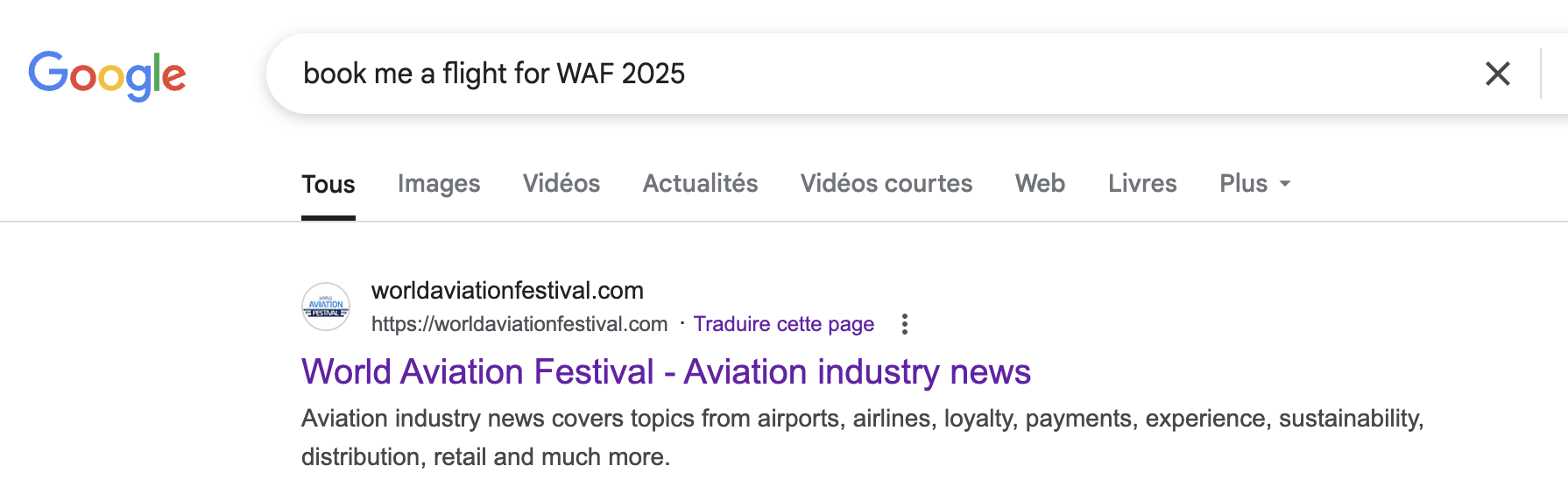
Traditional search, like Google, is based on keywords and returns websites. For example “book me a flight for WAF 2025” returns a list of websites including the website of WAF 2025, see below. Note that Google knows my search history and was able to provide the correct response in the first link. But Google cannot book flights (yet).
AI assistants are powered by Large Language Models (LLM) able to understand natural language. They take sentences (called “prompts”) as inputs and return sentences. For example “book me a flight for WAF 2025” returns a list of actions to book a flight on a website. See the illustration with two popular AI assistants, ChatGPT (4o) and Perplexity. Note that both know my search history for the past two years, both guessed that I was going to the Architecture (not Aviation) event and none bothered asking for disambiguation for facing a potential doubt.

ChatGPT’s interpretation—missing disambiguation

Perplexity’s answer—also assumed the wrong event
After arguing with ChatGPT it provided a link to TAP Air Portugal website for 6-10 Oct flight to Lisbon, unfortunately the best it could do was a link to the home page (not even a deep link): https://www.flytap.com/en_us/flights-from-geneva-to-lisbon?utm_source=chatgpt.com
In summary, today’s LLM-based assistants are natural language interfaces for web (and travel) search, with limited ability to handle ambiguity or execute transactions. The most recent example is Iberia’s integration in ChatGPT: https://worldaviationfestival.com/blog/airlines/iberia-brings-travel-to-booking-to-chatgpts-400m-weekly-users/. The current version is only available in ChatGPT and responds in Spanish only.
The promise of AI assistants for flight search
The promise of AI assistants is:
- Remove ambiguity
- Find the best option
- Complete the booking
These exciting next steps are not small upgrades. They represent a major shift from traditional browsing to acting with autonomy, comparable to the video recorder in a car that shifts to autonomous driving.
Removing ambiguity is what a human agent does when asking about dates, cabin, and other preferences. The current LLMs presume rather than ask, which is good for creativity in trip planning but risky for accurate travel bookings.
Finding the best option is what takes time in travel search today, especially as it was not designed for travel experience. For example, I want to search flights where the aisle seat on the exit row is available (convenient to open the tray table and work on a laptop during the flight). It is a painful search because it requires to search each flight, access the seat map and check availability. The best option includes the base fare and the ancillary price for the exit row seat.
Completing the booking requires access to personal information (date of birth, passport number or else) and to payment details (including mobile validation in case of secure payment features). Given the level of hallucinations of LLMs today, a validation step may still be required for the complete booking.
What will it take to get there?
At the AI assistant level, developments focus on accessing APIs rather than browsing webpages. This trend is related to “Agentic AI” which promises to take actions in an autonomous way. In the early days Google also pointed to the home page of airlines until it acquired the software company ITA and offered Google Flights with advanced flight comparison options.
At the airline level, developments coincide with the creation of “Offers and Orders” using APIs and continuous prices. Advanced airlines will expose a dedicated API to AI assistants that can make offers and service orders in a dialogue based on the NDC protocol (or whatever else agreed bilaterally).
At the Online Travel Agent (OTA) level, the history repeats itself. When the internet emerged, digital players like Expedia and Booking were faster and more focused than airlines in building the user interfaces and experience. As AI assistants are emerging, the race is on to develop the best user experience in travel search.
Who will win the travelers’ choice? AI assistants, OTAs, airlines or new entrants? The show has just started.
Conclusion
The “impatients”, who said that AI is slow (first neural networks in the 1990s), that NDC is slow (first standard in 2012), will find that GenAI and LLM are slow too (ChatGPT v3.5 was released in December 2022). I’ve asked ChatGPT itself for a forecast, as “Operator”, its “concierge”, is still in internal testing:
- 2025: autofill (+ handoff for payment)
- 2026: full booking “certified platforms” (with full agent delegation)
- 2027: end-to-end travel assistant (“concierge”) with payment, passport, and personalized services
Whenever an AI assistant books my next flight, it will nicely close the loop after programming neural networks in 1995 and launching NDC in 2012. How will you feel when an AI assistant fully books your next flight?
Notes:
- this article was improved for accuracy and readability using spell check in MS Word and ChatGPT-4o
- GPT is also the airport code for Gulfport-Biloxi International Airport in Mississippi. https://www.flygpt.com/
For more from Léopold see:
- Five post-recovery trends shaping the airline industry in the Asia Pacific region
- Will AI Agents make online travel agents look old-fashioned?
- What does airlines’ New Payment Capability (NPC) look like?