Inflight entertainment and connectivity (IFEC) has become one of the hottest topics in the aviation industry thanks to recent innovations. Low-earth orbit (LEO) satellite connectivity is bringing high-speed WiFi into the cabin, allowing passengers to browse the Internet as they would at home. And as more passengers use their personal devices inflight, airlines are accessing new opportunities to get closer to their customers.
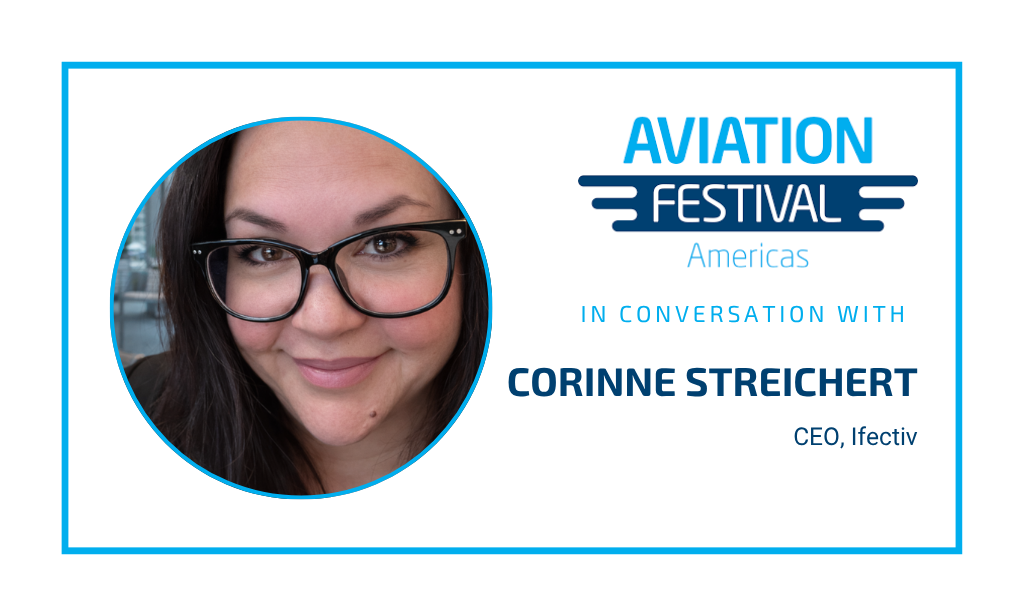
To get an expert analysis of these trends ahead of Aviation Festival Americas, we sat down with Corinne Streichert, CEO of IFECtiv. While IFEC is often viewed solely as a revenue driver, through content partnerships, loyalty offers, and sponsorship, Streichert argues airlines cannot afford to overlook the operational efficiency gained from effective inflight systems: leveraging connectivity for effective maintenance, monitoring, and crew management can also contribute to lower costs.
In my mind, that’s what makes a really great IFEC experience, one that delivers to the customer and one that also delivers operationally back to the airline,
Connectivity is set to become more powerful than ever thanks to the expanding installation of LEO satellite-powered WiFi. In this field, SpaceX’s Starlink project has the first-mover advantage, with a roster of airline partners now spanning IAG, Lufthansa Group, and United Airlines. But the field is growing more competitive: Delta just signed a deal with rival provider Amazon Leo, which could prove to be a powerful force thanks to its integration in the Amazon ecosystem. Meanwhile, other services including Eutelsat’s OneWeb are also developing at pace. Streichert notes:
When we really look at it, airlines are not buying fast Wi-Fi. They’re buying, passenger experience, network downtime, certification, simplification, the kinds of features that help them manage, implement, and manage the IFEC moving forward. I think the provider that can meet a lot of those needs and demands of the airlines are the ones that are going to really stand out.
Of course, LEO satellite connectivity is no one-stop solution for airlines. It’s a sizeable investment that will likely be beyond the reach of many low-cost carriers (LCCs), who are already getting squeezed by higher jet fuel prices and market fluctuations. Advances in technology are making it easier to bring connectivity onboard cheaply and without adding weight or maintenance complexity. A range of choices are open to LCCs depending on what they want to achieve.
There isn’t one specific solution. It really goes down to what airline you want to be, what service you want to offer to your passengers, and doing that within your cost structure.
At Aviation Festival Americas, Streichert will be chairing our IFEC interviews and panels. Featuring LCCs and full-service carriers, the discussion will touch on how airlines can deliver a seamless inflight experience when passengers expect to receive everything at their finger tips. Given all the developments in motion, Streichert is excited to hear more from leaders in the space:
All eyes are on the LEO multi-orbit solution, but we do see a lot happening in the seatback space as well, with a lot of new products coming out, a lot of new applications, a lot of new partnerships as well. I think that will give us some insight into what airlines are thinking.
It’s not too late to join us in Miami, 3-4 June, for Aviation Festival Americas 2026! Register to attend here.
🎥 Watch the video to get the full interview with Corinne Streichert.
Questions asked include:
- With highspeed inflight connectivity becoming increasingly standard, how can airlines monetise this opportunity successfully?
- Which airlines in the Americas are delivering the best IFEC experiences at the moment, whether through personalisation/loyalty/something else?
- What about LCCs? What are the best improvements carriers can make while keeping costs low?
- You’re leading our inflight connectivity track at AFAM 2026. Which conversations are you most excited to have/speakers you’re keen to hear from at the event?
For more like this, see: