Which technologies are changing the way airlines operate?
Join us to follow a flight’s journey from preparations on the ramp, to managing the aircraft in the air and finally handling baggage post-flight using new technologies and up to the minute data.
Turning around an airplane between flights involves more than restocking drinks and a quick refuel. A typical turnaround involves more than 75 different people and entities. Minimizing the time this takes is crucial to not only keep customers happy but to improve cost efficiency and reduce emissions.
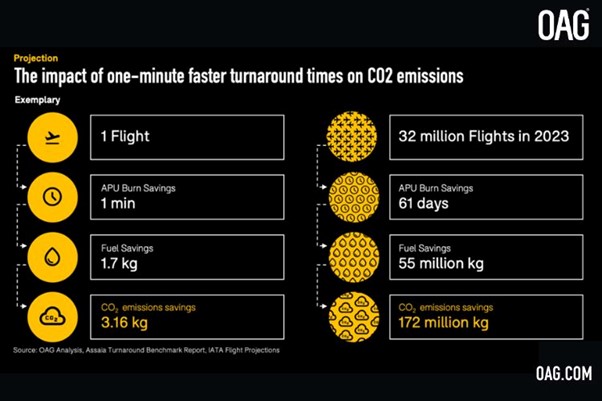
So, how can airlines improve turnaround times? There are three phases of innovation to be considered:
- Manual Optimization. For example, Delta Airlines tweaked the angle at which aircraft are pushed away from the gate. A shift from 90 degrees to 45 degrees saved the company a minute or two each time, which all adds up.
- Smart Visibility. This phase uses technology to monitor ongoing processes and enhance planning. Travel-tech startup Assaia employs a synergy of AI and computer vision. Its solution can, as one example, assist in efficient de-icing processes by integrating data from the gates, the de-icing pad, and other essential inputs. Assaia’s tech suite claims over 12% turnaround time improvements.
- Integrating AI. The future could include an automated ecosystem where every piece of data is acted upon in real-time. The “Deep Turnaround” system at Amsterdam Schiphol Airport tracks over 70 steps in the aircraft turnaround process to predict its duration and estimate when a plane is ready to push back from the gate.

Flight planning currently involves airline dispatchers collaborating closely with pilots to ensure safe and efficient routing, but two key challenges mean that more integrated technology solutions may be needed to enhance the precision and adaptability of the process.
-
- More severe weather considerations. Three-quarters of all flight delays are caused by weather conditions, but emerging technologies can predict and plan ahead for adverse weather. JetBlue estimates an annual reduction in operational costs of close to $4 million USD from using Tomorrow.io’s advanced weather forecasting tech.
- More air traffic. Next-generation AI platforms use traffic information based on scheduled and active flights to formulate flight paths that dodge congested zones. Alaska Airlines has partnered with Airspace Inteligence, whose Flyways AI platform suggests optimal routes. As a result, the airline saved 480,000 gallons of fuel in 6 months and between Jan – Sep 2022, the AI contributed to an average time saving of 2.7 minutes per flight.

Post-flight, passengers head to the baggage belt to claim their luggage, but for a minority of unfortunate travelers the bags they’re waiting for don’t appear and are either returned later, damaged or never seen again. The mishandled baggage rate escalated from under 0.5% of all passenger bags pre-pandemic to nearly 0.8% in 2022.
Problems often occur when handling systems do not have enough time or manpower to transfer bags between flights, so amidst an airport labor shortage, how can this gap be bridged?
Key to this process are baggage management solutions that integrate with various airline systems, from flight information to booking and departure control, sharing real-time updates across all relevant teams. Advanced software systems also aim to balance tail-to-tail transfers, considering resource availability and workload. At Singapore Changi airport, the fully automated Early Baggage Storage (EBS) system features automated cranes that manage luggage storage and retrieval across a 13 km subterranean network, connecting three terminals. The shift to full automation has allowed the airport to free up to eight workers per shift to do more productive work.
This is an overview of a new report from OAG: The Future of Innovative Airline Operations. Download the report now.
For more from OAG also see: OAG The Airline Tech Transition: A Journey Towards “Travel Done Right”