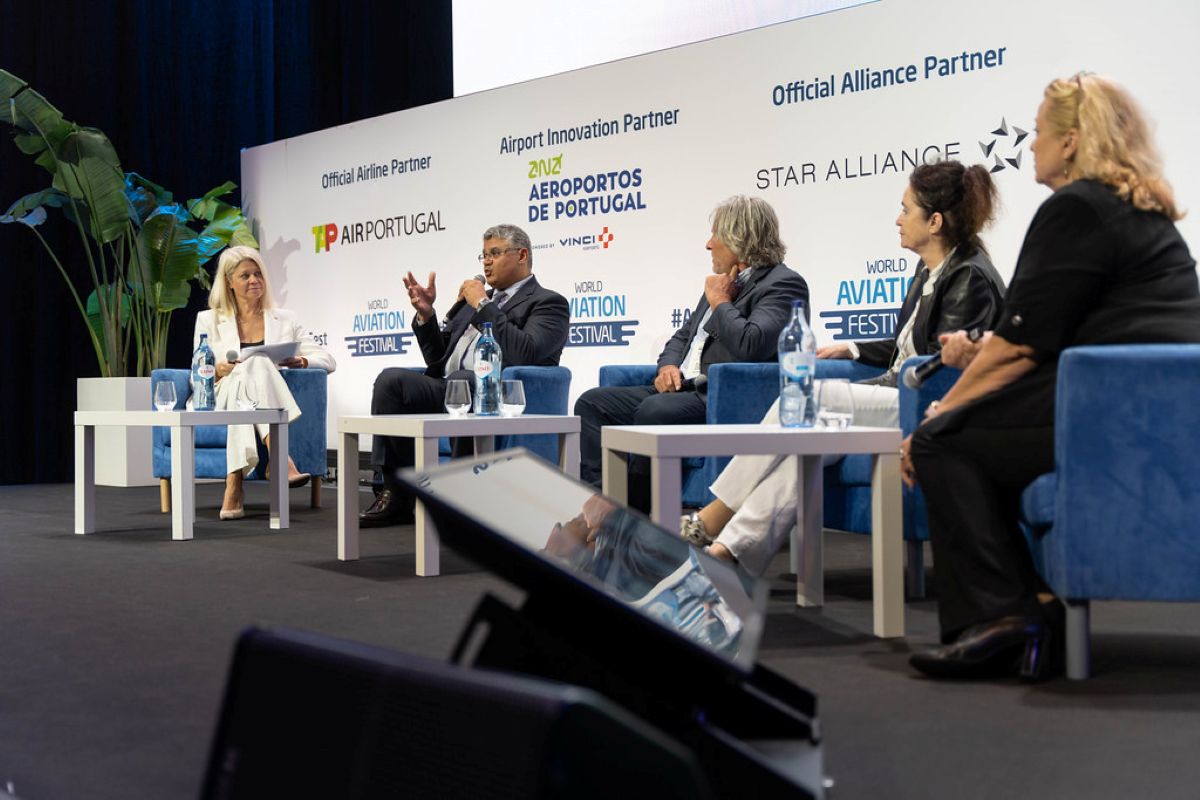
In this keynote panel from World Aviation Festival 2025, four airports leaders shared their transformation strategies for creating an experience that aligns with modern passenger expectations. From cutting-edge sustainability to a digital-first experience, together the panel delivered holistic insights on airport development in the modern age.
Moderated by Jane Witherspoon, Bureau Chief for Middle East, Euronews, the panel included:
- Mazen Johar, CEO, Jeddah Airports
- Bettina Ganghofer, CEO, Salzburg Airport
- Dan Mann, Executive Director, Louisville Regional Airport Authority
- Meiltje de Groot, CEO, Groningen Airport Eelde
De Groot kicked things off, discussing how collaboration has helped drive development at the Netherlands’ smallest airport. Its flagship Hydrogen Valley project would not be possible without the private companies, governments, and educational institutions who are truly committed to taking hydrogen power to the next level.
We are a small airport, and as you know regional airports often have difficulties in their finance, and getting money to pay for innovations. The only solution for us is to work together.
Dan Mann also shared how sustainability is shaping the SDF Next project at Louisville Muhammed Ali International. Among the significant developments of the US$1 billion trasnformation are geothermal wells, which have saved the airport US$400,000 annually in energy costs. Other tech innovations include upgraded baggage claim and a collaboration with GoodMaps, a company with origins in Louisville that is committed to making travel more accessible for the blind and visually impaired.
I think a lot of people are independent travellers, and that’s great and the tech is great, until something goes wrong. Then you still need what I call ‘hand-to-hand combat’, that person who can answer the question and help guide them when things don’t work as they should.
Balancing technology while still providing in-person interactions where needed was a dominant theme of the discussion. Johar noted:
At Jeddah Airport, one of the challenges we have is around 30% of our travellers are first-time travellers. So they come with expectations, they come stressed. So we need to make sure we take them hand-in-hand through the processes, and that’s what makes it challenging to design different processes from your passenger profile.
Salzburg and Groningen are two smaller airports, making their attitudes to tech more different. Ganghofer and de Groot both highlighted that their compact footprint makes some initiatives such as digital maps and biometrics less necessary for efficiency. Nevertheless, Ganghofer is open to AI, especially for optimising key bottlenecks such as baggage claim and delivery.
As a smaller airport, we can’t do it all, but we will implement this technology where it makes most sense for the customer.
The best initiatives combine efficiency with connectivity and sustainability to build high-impact, resilient infrastructure. Intermodal connectivity is increasingly a focus, as airports seek to strengthen partnerships with rail and other travel operators. Johar highlights the success of the high-speed Haramain train, which connects the airport to the popular pilgrimage sites of Medina and Mecca.
This train completes around 150 trips a day. Last year it served 9 million passengers, and saved about 80,000 tonnes of carbon emissions. So for us, that’s a way of improving the passenger experience, helping sustainability, and providing strong infrastructure for future growth.
🎥 Watch the interview to hear the panel’s full discussion on building tailored, green, efficient, and digital airports.
Join us at World Aviation Festival 2026 to discuss the future of global airport development.
For more like this, see: