In 2025, global air passenger numbers will approach the 10 billion mark for the first time, with ACI predicting a total of 9.8 billion passengers. This figure is set to double by 2042: good news for industry revenue, but a huge problem for airports who will have to manage more travellers than ever before.
Some countries have decided the only way to manage traffic is to build an entirely new airport. Five such projects are some of the biggest infrastructure developments in the world, with plans to manage tens of millions of passengers each. World Aviation Festival takes a look at where they’re building, why, and what impact the new airports will have on travel in the region.
Long Thanh International Airport (Ho Chi Minh City, Vietnam)
Vietnam’s newest airport will service traffic at its southern capital, Ho Chi Minh City. The existing Tân Sơn Nhất International Airport (SGN) has a capacity of 30 million passengers, which it exceeded many years ago. Tourism is a major factor in Vietnam’s aviation boom, with traveller numbers up by 21.5% in 2025 alone.
The new Long Thanh International will be able to process 100 million passengers a year when complete. The first phase of the project is due to be completed early in 2026, at a cost of US$7.8 billion. During this transition period, it is expected that national carrier Vietnam Airlines will move to Long Thanh, with Tân Sơn Nhất hosting low-cost carriers, including Vietjet.
The Long Thanh terminal building is being designed by renowned South Korean architect firm Heerim. Inspired by the lotus, Vietnam’s national flower, Heerim will leverage the latest technology and cutting-edge design to give passengers a seamless experience. High-speed and light rail lines will connect the airport to the centre of Ho Chi Minh City, as well as nearby Thu Thiem, making the airport a true gateway to Southern Vietnam.
New Manila International Airport (Manila, Philippines)
A growing middle-class market, the rise of budget carrier Cebu Pacific, and ongoing investment has produced increased demand for air travel in the Philippines.
Southeast Asia will gain another airport when the New Manila International opens at the end of 2028. Ninoy Aquino International, which currently serves the capital, is also undergoing a significant redevelopment as the country oversees an overhaul of its aviation capabilities.
When complete, the New Manila airport will be able to handle 100 million passengers a year. Built on reclaimed land 45 kilometres northwest of central Manila, the airport will be supported by a new highway, bus terminal, and possibly a metro extension.
Dubai World Central Al Maktoum International Airport (Dubai, UAE)
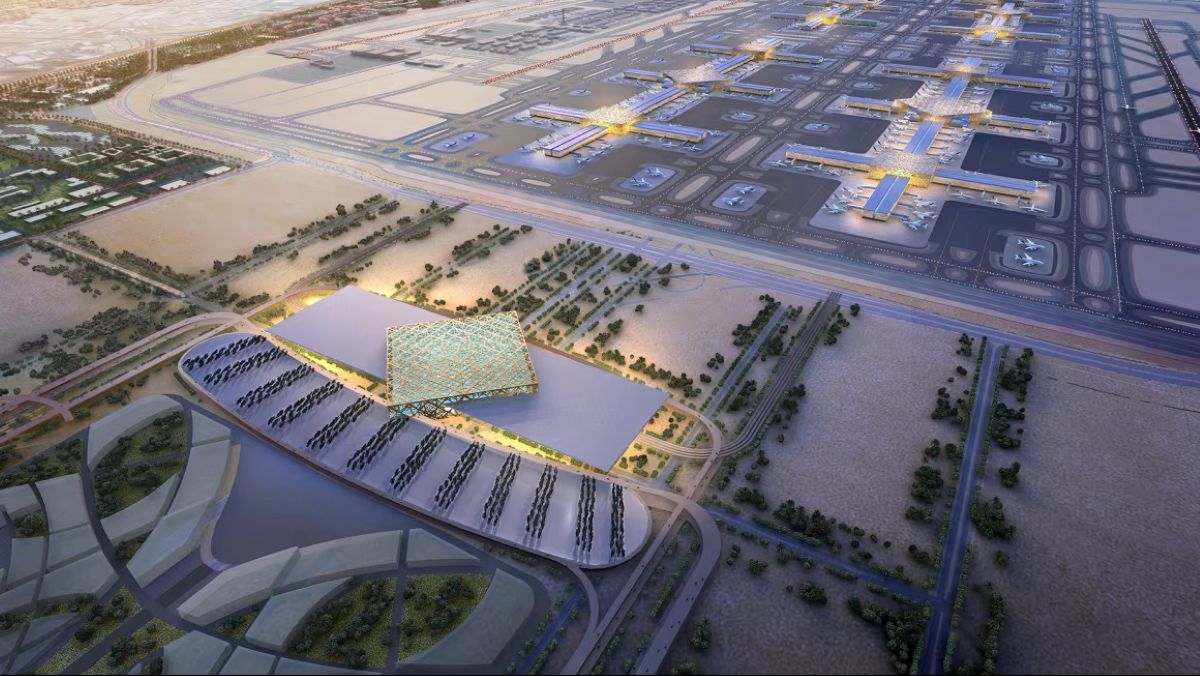
Covering a staggering 36,000 acres, Dubai World Central will be the largest airport in the world when completed. As traffic in the UAE’s biggest city continues to increase — it expects to welcome 150 million air travel passengers by 2032 — the new airport is needed to support and eventually supplant the existing Dubai International site.
Al Maktoum International currently handles cargo and some passenger flights, but in the future the airport will become Emirates’ and flydubai’s major hub. The first phase of the new airport will open in 2032, with the finished site having capacity for 260 million passengers. Plans call for an impressive five runways and 400 gates.
Dubai Airports CEO Paul Griffiths has made clear that his priority lies in tech investment for a frictionless, stress-free airport experience. Initiatives such as the ‘document-free’ departures corridor introduced at Dubai International give an idea of the forward-thinking, tech-focussed features we can expect to see when Dubai World Central opens its doors.
King Salman International Airport (Riyadh, Saudi Arabia)
An airport that could rival Dubai World Central in size and scale is the planned King Salman International Airport across the border in Saudi Arabia. Through its Vision 2030 initiative, Saudi Arabia hopes to challenge the UAE as an international hub for travel, tourism, and sport. The launch of new national carrier Riyadh Air is one of many projects that hope to put the Kingdom on the map as a future-forward, wish-list destination.
Built over the existing King Khalid International Airport, King Salman International is being developed in partnership with architects Foster + Partners and engineer consultants Jacobs. Little else is known about the new project, proposed in 2022 by Crown Prince Mohammed bin Salam, except that the 14,000 acre site will have six passenger terminals, six runways, and capacity for 195 million passengers a year by 2050.
Western Sydney International Airport (Sydney, Australia)
Western Sydney International will finally commence operations in the second half of 2026. The long-awaited opening will relieve traffic at the existing Sydney Kingsford Airport, which has been operating for over a hundred years.
The new airport will be operational 24/7, and is expected to process over 80 million passengers by the 2040s. Promising travellers a seamless and sustainable experience, rail and bus links will help ferry passengers to Australia’s biggest city, as the country prepares for tourists to spend A$223 million in the country by 2028.
Centralny Port Komunikacyjny Airport (Warsaw, Poland)
As APAC is expected to be the fastest-growing region for air travel, airports in that area have dominated this list. However, one big new airport is opening in Europe: Centralny Port Komunkacyjyn Airport in Warsaw, Poland.
The Eastern European’s economy has doubled in the past decade, and is soon set to outstrip major powers such as the UK and Japan. With increased wealth has also come increased demand for air travel, driven further by Poland’s rising volume of tourists.
Centralny Port Komunikacyjny is Europe’s first greenfield airport project in years. Expected to open in 2032, it will become Poland’s international aviation hub even after Warsaw’s existing Chopin Airport undergoes much-needed renovations. The master plan anticipates the site eventually handling 60 million passengers a year, with a new high-speed rail linking passenger to the Polish capital.
A state-of-the-art baggage system and sustainable design are other features that hope to put Centralny Port Komunikacyiny on the map as Europe’s best airport.
Join us at Aviation Festival Asia 2026 to hear from industry experts on future-proof airport development and the growth of air travel in the region.
For more like this, see: