Based on more than 34 million flights analysed, Estuaire publishes its first Contrail Opportunity Index together with 
Already dealing with huge challenges, airlines face a mammoth task to achieve their net zero targets, and are in urgent need of solutions. The current discourse mostly focuses on reducing in-flight CO2 emissions through Sustainable Aviation Fuels, alongside emerging electric and hydrogen technologies, but these solutions may take decades to scale effectively. Reducing contrails, which account for a significant proportion of the sector’s total radiative forcing impact, offers a far more immediate upside opportunity. In this paper we draw on fresh research to quantify and understand that opportunity in the context of ongoing industry initiatives.
Contrails: the challenge and the opportunity
The mechanism by which contrails can exacerbate global warming has been understood since the 1990s, when NASA’s Patrick Minnis first highlighted their radiative forcing effects. Under certain atmospheric conditions, they persist as cirrus clouds, which cause cooling when they reflect incoming sunlight back into space, and warming when they trap heat radiating from the earth’s surface. While the cooling effect of contrails is thus limited to daylight hours, their warming effect persists around the clock. Consequently, without proper management, their net impact is to contribute to temperature rises.
Recent scientific advancements have deepened our understanding of this impact, though estimates remain variable. Crucially, individual flights experience varying degrees of contrail impact according to different operational characteristics, such as:
- Geographic location: different regions exhibit distinct weather patterns, influencing contrail formation.
- Aircraft and engine specs: different types of aircraft and engines in use affect flight altitudes and emit varying levels of soot, a key factor in ice nucleation and contrail formation.
- Flight timing: flights departing in the afternoon tend to contribute to a higher contrail impact, as the contrails formed during this period are eventually persisting into the night.
- Weather: humidity, temperature, and atmospheric pressure all impact contrail formation, with contrails more likely to form in colder temperatures and higher humidity.
Most contrail impact is generated by flights to and from Europe and North America, where larger volumes of commercial air traffic frequently intersect with conducive atmospheric conditions for contrail formation. Other regions with high traffic, such as Asia Pacific, observe lower contrail impact, largely because of less contrail-prone cruise altitudes, as well as weather phenomena such as the Hadley Circulation.
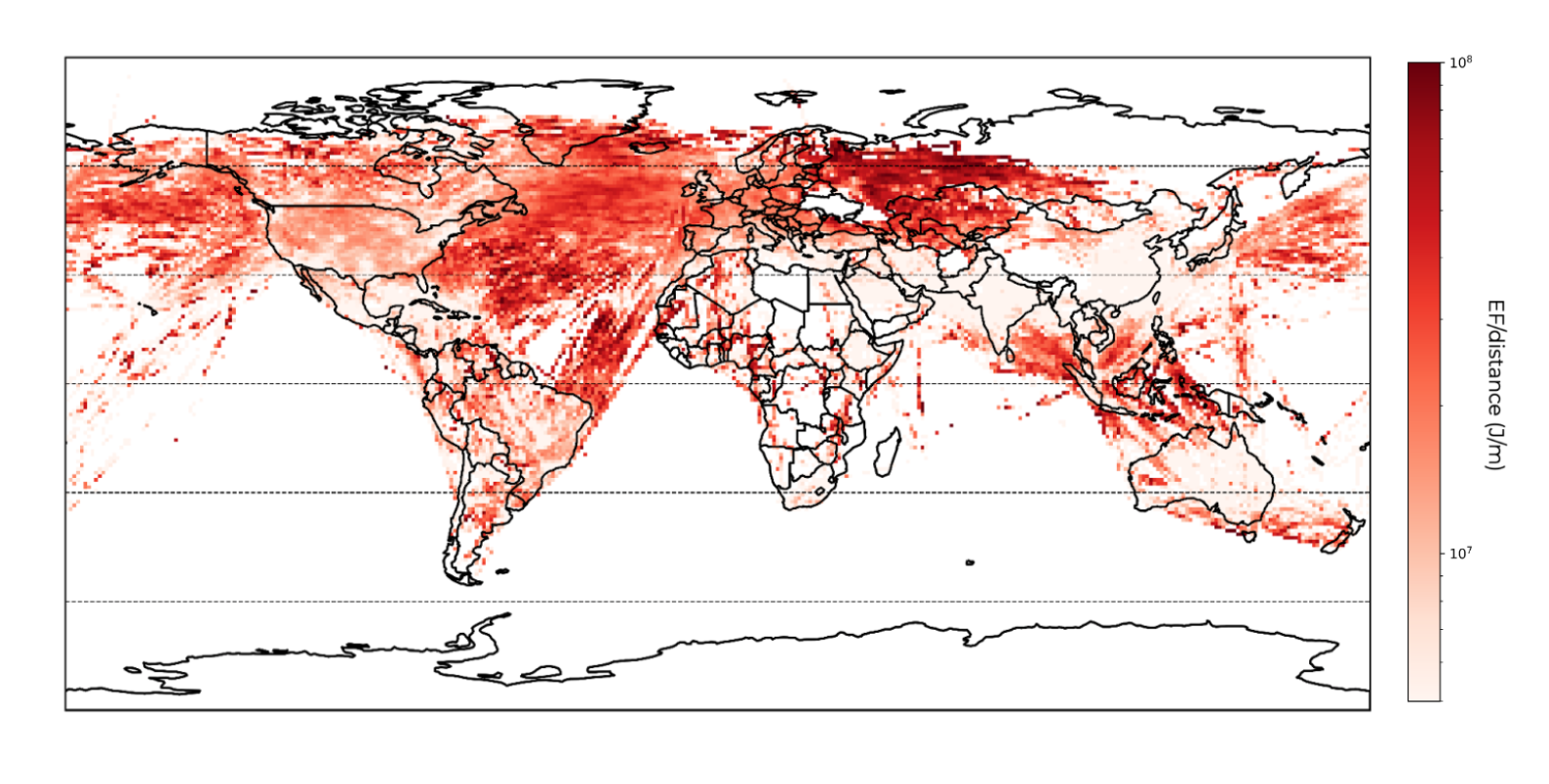
CONTRAIL ENERGY FORCING PER DISTANCE FLOWN
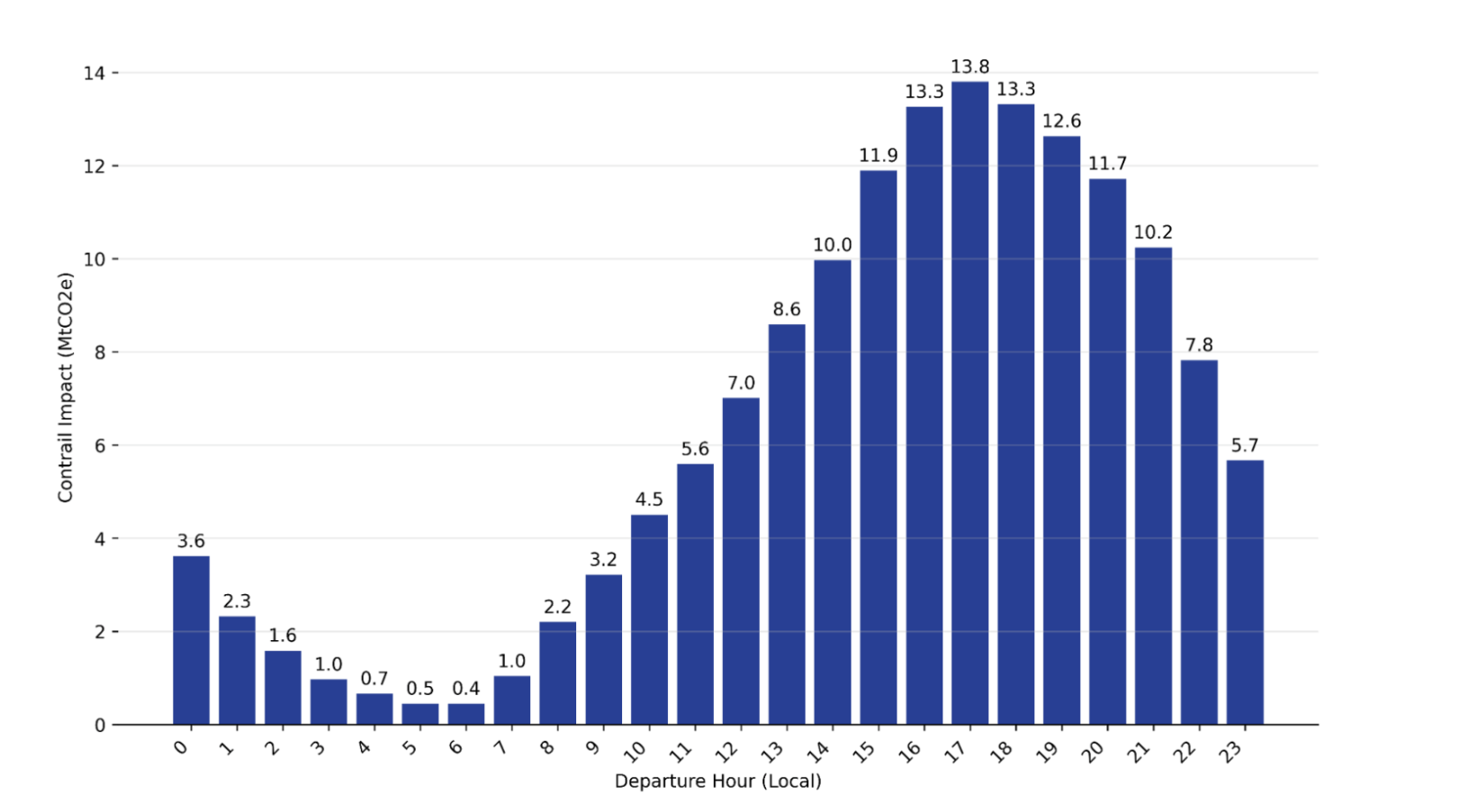
CONTRAIL IMPACT BY DEPARTURE HOUR
The Contrail Opportunity Index
Climate data platform Estuaire has recently conducted an analysis of 34,388,000 commercial aviation flights to estimate both the CO2 emissions and additional radiative forcing from contrails. This analysis adopted a detailed flight-by-flight consideration of actual aircraft trajectories, using a dataset that includes all flights operated by commercial passenger and cargo aircraft in 2023. This approach computes the climate impact of each flight, encompassing not just CO2 emissions, but other factors like contrail radiative forcing, allowing us to build a more granular picture of contrail impacts at the individual airline level.*
The likes of the EU and Intergovernmental Panel on Climate Change have placed the contrail effect at up to 60% of aviation’s effective radiative forcing.1,2 With the assumptions around CO2 equivalent calculations still a matter for debate among scientists, Estuaire have adopted conservative CO2 equivalent conversion assumptions for the purpose of this analysis, which suggests that contrails contribute a warming equivalent to 18% over and above the direct CO2 emissions caused by flights.
The size of the prize

These figures are highly relevant in the context of the EU’s imminent plans to introduce a new Monitoring, Reporting, and Verification (MRV) scheme for aviation’s non-CO2 environmental effects, including contrails. By the end of 2027, based on the results from the application of the MRV framework for non-CO2 aviation effects, the EU will work on a legislative proposal to mitigate non-CO2 aviation effects by expanding the scope of the EU ETS to include non-CO2 aviation effects.
Today, opinions differ on whether the monitoring scheme should encompass all flights that depart from or arrive in EU member states, or remain limited to intra-EU flights only, to already align with the scope of the EU Emissions Trading Scheme (ETS). In either case, the contrails impact remains large.

Crucially, however, this impact is very unevenly distributed. In fact, according to Estuaire’s analysis, in 2023 just 2.9% of flights generated 80% of the total radiative forcing effect of contrails. This insight represents a huge opportunity: for most airlines, substantial climate savings can be realised with minimal fuel penalties by rerouting only a small number of flights. Estuaire’s analysis makes this clearer at the airline level, where those airlines with the highest potential for contrail management can be ranked accordingly. In the following table, we have redacted this initial ranking, but for sector transparency seek to open this up in collaboration with airlines over time.
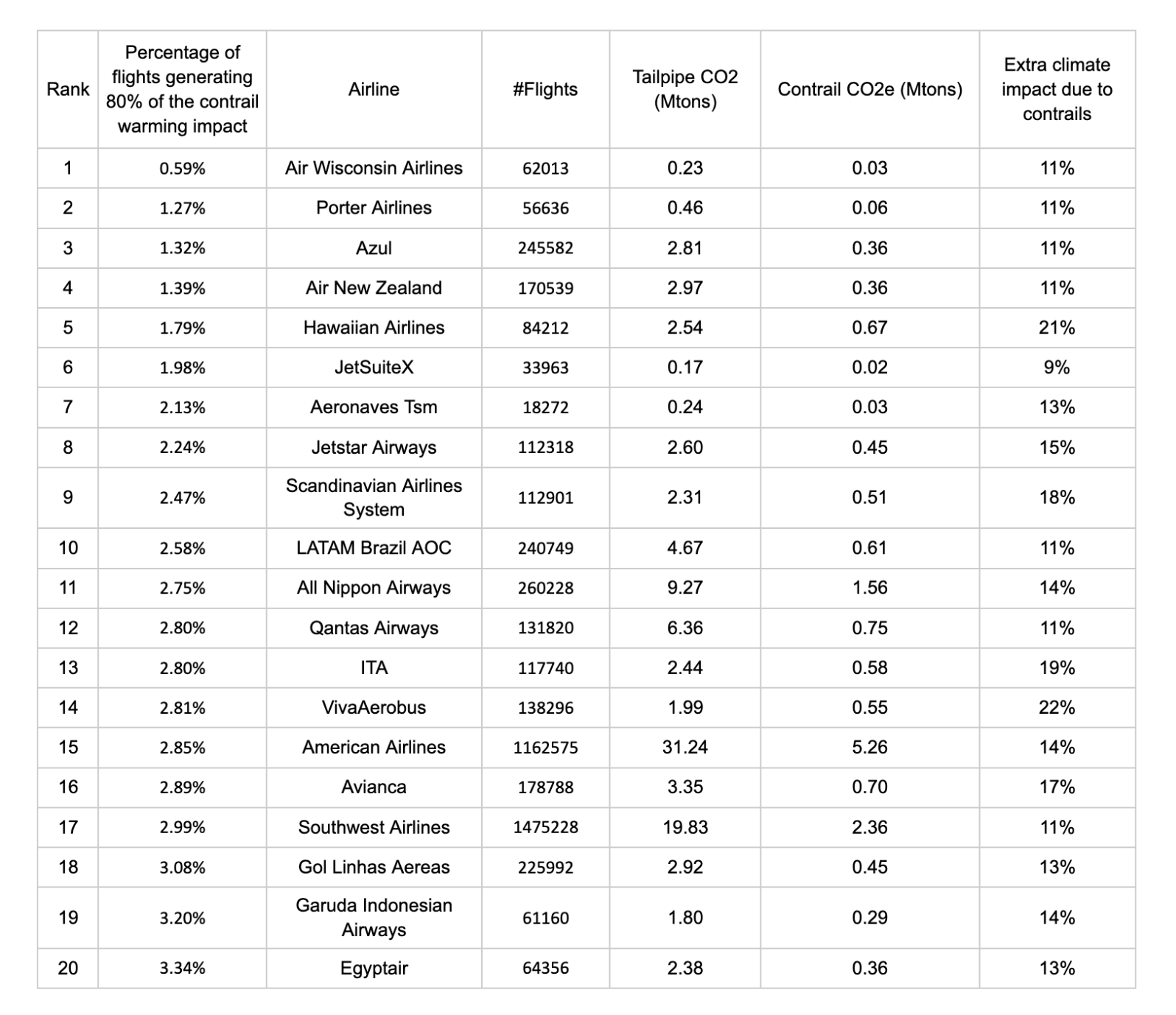
CONTRAIL OPPORTUNITY INDEX
Source : Estuaire data, airlines selected have more than 50 aircraft in fleet and a Contrail Impact as % of total greater than 10%.
As the aviation sector grapples with fuel efficiency, Sustainable Aviation Fuels, and other levers for reducing its environmental impact over the long term, contrail mitigation offers a realistic means of reducing its impact in the current decade and demonstrating much-needed progress. By adopting advanced contrail mitigation technologies, airlines can make a profound impact on reducing their environmental footprint.
WAF attendance
Our attendance at the World Aviation Festival will be an opportunity to explore these advancements. We will be part of the digital sustainability panel, where we will share in-depth insights on the importance of monitoring the non-CO2 effects of aviation, targeted SAF allocation to contrail-prone flights, as well as the new regulations related to non-CO2 emissions that are coming soon.
Article by Estuaire
[1] https://www.ipcc.ch/report/ar6/wg3/downloads/report/IPCC_AR6_WGIII_Chapter10.pdf (PDF, 3.3MB);
[2] https://www.imperial.ac.uk/news/242017/clouds-created-aircraft-have-bigger-impact/