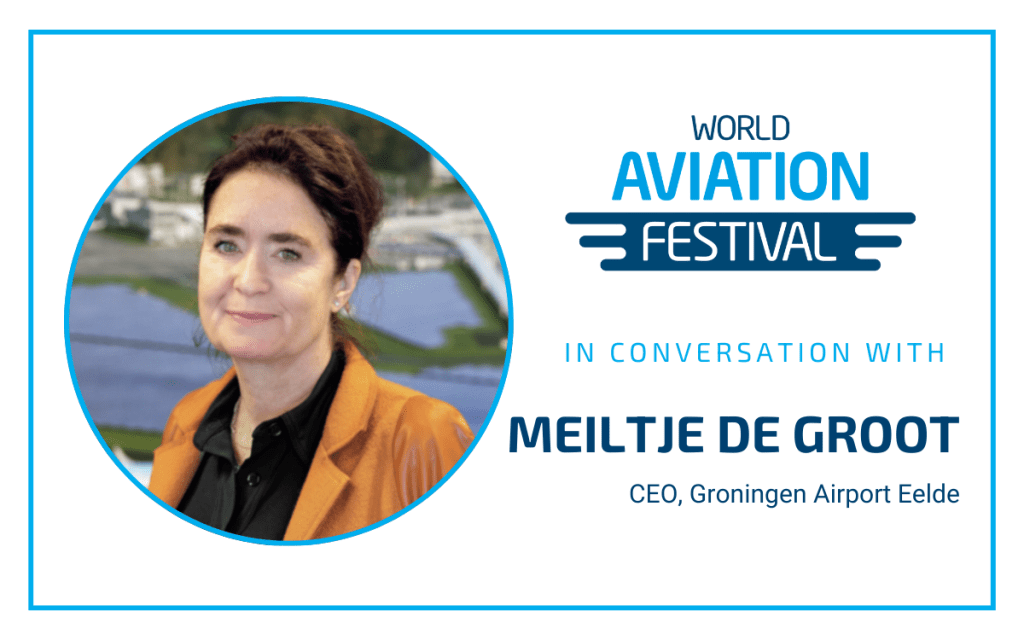
Groningen Airport Eelde in the Northwest of the Netherlands handles around 120,000 passengers a year, connecting locals in the region to popular holiday destinations including the Channel Islands, Spain, and Turkey.
However, with passenger numbers still down from pre-Covid-19 levels, and aviation taxes lower in neighbouring Germany, the airport has been forced to innovate to stay in the game. Sustainability and social initiatives are at the heart of the Groningen’s future-forward programme, directed by CEO Meiltje de Groot.
The good thing about being small is we get to work together. On the other hand, sometimes it’s difficult because the big airports have more resources. But it creates a more innovative environment.
Groningen wants to become Europe’s first Hydrogen Valley Airport. Strategically positioned near Dutch seaports, the airport has developed a 22-megawatt solar farm, which de Groot hopes will one day produce hydrogen without generating any carbon emissions. While Groningen’s roster of partners include Airbus and Shell, building out the infrastructure to make hydrogen and electric aircraft a reality is no easy feat.
We have to do a lot of studies about how it’s going to work. How will we fuel the aircraft? Will it be safe? How do we get the hydrogen to the airport, or can we produce it ourselves? So there’s a lot to invest in at the moment.
Significant progress has already been made, with a hydrogen ground power unit (GPU) in the proof-of-concept stage. But sustainable aviation isn’t Groningen’s only ESG mission. A long-time partner of KLM’s Flight Academy, the airport is scaling its training and upskilling initiatives to create an Airport Campus where students can invaluable gain real-world experience. CAE currently predict that the aviation industry will face a shortage of 1,465,000 professionals over the next decade, making Groningen’s contributions essential.
Because we are a small airport, the government has to subsidise us for several services we offer, but the Airport Campus means we can give something back.
Watch the interview to hear Meiltje de Groot discuss Groningen Airport Eelde’s sustainability and social projects.
Questions asked include:
- What kind of unique challenges have smaller airports faced in recent years that bigger airports might not have?
- You have an ongoing partnership with Amsterdam Schiphol airport. Could you share a bit more about this, what kind of mutual benefits there are to this partnership and why collaboration is so important in the industry?
- Groningen is positioning itself as a Hydrogen Valley Airport. Could you tell us a bit more about this project and what kind of impact it could have on sustainability?
- Groningen is also investing in training for pilots and airports staff. Why is this so important and what are you hoping to achieve through these programmes?
Join us at World Aviation Festival 2026.
For more like this, see: