By Gaurav Passi, Founder and CEO, Zingly
Think about the last time a flight of yours really went wrong. Not a short delay, but a proper disruption: a cancellation, a missed connection, a bag that ended up in a different city. Now count how many times you had to explain the situation from the beginning.
For most travellers the answer is at least three. Once to the app or chatbot, once to someone on the phone, and once more at an airport desk, where the person in front of you had no idea what had already been agreed. Each of those interactions may have gone fine on its own terms. The journey as a whole still felt broken.
That, I’d argue, is the central problem in airline customer experience today, and it isn’t the one most of the industry’s investment is aimed at.
A decade of better conversations
Airlines have put serious money and effort into the front end of service. Chatbots and voice assistants are far more capable than they were even three years ago. Large language models can understand a passenger typing in a hurry, in their second language, at 2am. Many carriers now handle a big share of routine enquiries without a human getting involved, and the dashboards show it.
On the commercial side, the move towards offers and orders has started to loosen the grip of legacy distribution. Airlines can increasingly price, bundle and sell the way modern retailers do.
Both are real progress. But look at where passenger frustration concentrates, and where contact centre cost really sits, and you find a different set of problems: disrupted itineraries, refunds, baggage claims, special assistance, group changes. None of these are single conversations. They unfold over hours or days, across channels, and usually involve more than one team and more than one system.
Three gaps
In our work with airlines, three gaps keep coming up.
The first is time. Most service tools think in sessions. When the chat window closes or the call ends, the context goes with it, even though the passenger’s problem is still very much open.
The second is channel. Passengers move freely between the app, the phone, messaging and the airport. The systems behind them usually don’t. The booking record travels, but the story of what has happened since doesn’t.
The third, and the most expensive, is the handover between AI and people. A bot gathers the details, reaches the limit of what it’s allowed to do, and passes the passenger to an agent who starts again from scratch. That’s the moment passengers remember, and it’s where a lot of containment gains quietly leak away as repeat contact.
Underneath all three sits the PNR, which was built to record a transaction. It was never meant to capture a journey, with everything that happens to a passenger after they’ve paid.
What good looks like
If you design around the journey rather than the interaction, a few principles follow.
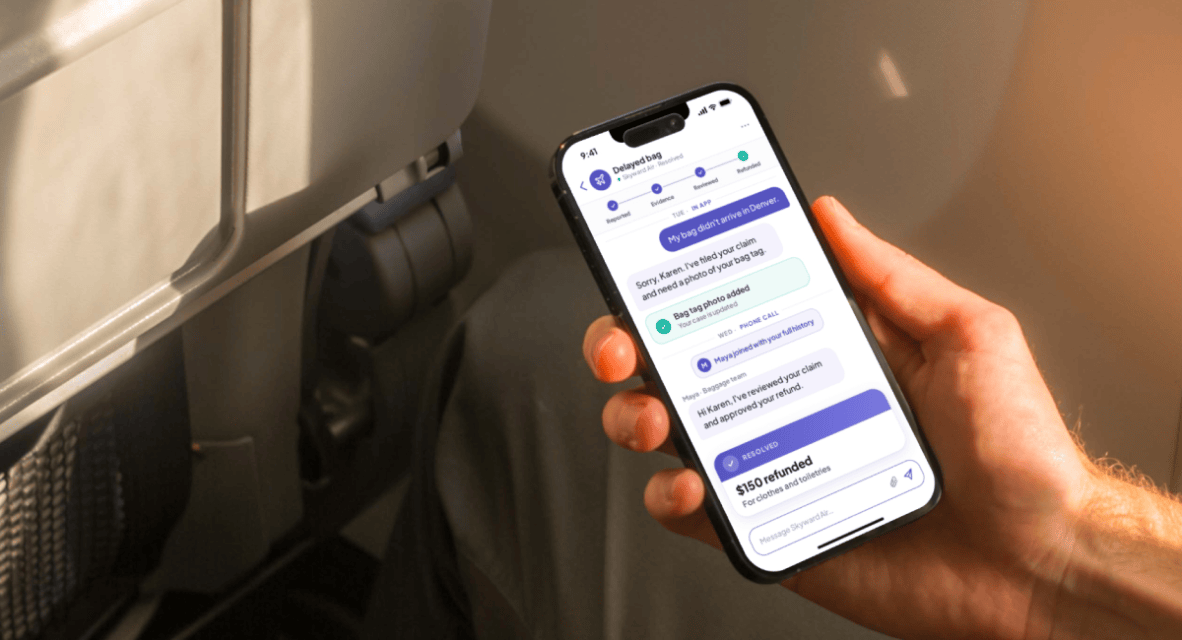
Every open problem needs a home that persists: somewhere the case lives from the moment it starts until it’s resolved, whatever the channel and whoever is working on it. The passenger should be able to pick it up tomorrow, on a different device, and carry on.
AI should do things, not just answer things. Rebooking, issuing a refund, requesting evidence, updating a record. An assistant that can only explain the policy has solved the easy half of the problem.
People should be brought in for judgement, and should inherit everything when they arrive. The best use of an experienced agent is the case that’s genuinely unusual, not retyping details the passenger has already given.
And there should be one record of what happened, whoever did it. With passenger rights rules tightening in more markets, that’s no longer a nice-to-have.
Changing what we measure
Containment rate and average handling time made sense when the goal was keeping volume away from agents. They’re less useful once AI is doing real work. A contained chat that leads to two phone calls and an airport visit looks good in one report and terrible in the passenger’s memory.
Better questions are harder to answer but much closer to what drives loyalty. How many journeys closed properly at the first attempt? How long did it take from the problem arising to it being resolved? How many passengers had to repeat themselves?
There’s a commercial point here too. Service moments are some of the highest-intent moments in the whole relationship. A passenger being rebooked is making a buying decision, whether or not anyone treats it as one. Airlines that resolve the problem first earn the right to offer the better seat, the flexible fare or the lounge pass. Those that lead with the offer usually find it lands badly.
Where to start
The temptation is to begin with the easy stuff. I’d suggest the opposite. Pick one high-volume, multi-step journey that frustrates passengers and staff alike, such as a baggage claim or rebooking during irregular operations, and make it work properly from start to finish. It will tell you more about your systems, processes and data than a hundred automated FAQs.
That’s the approach Pegasus Airlines has taken with us at Zingly, starting with baggage before moving on to disruption. It’s early days, but it has already changed how both teams think about what service technology is for.
The conversation will always matter. Passengers, though, judge an airline on whether their problem got solved, and that only shows up across the whole journey.
Next steps: Zingly for airlines | Request a demo | Zingly Use-Case Video