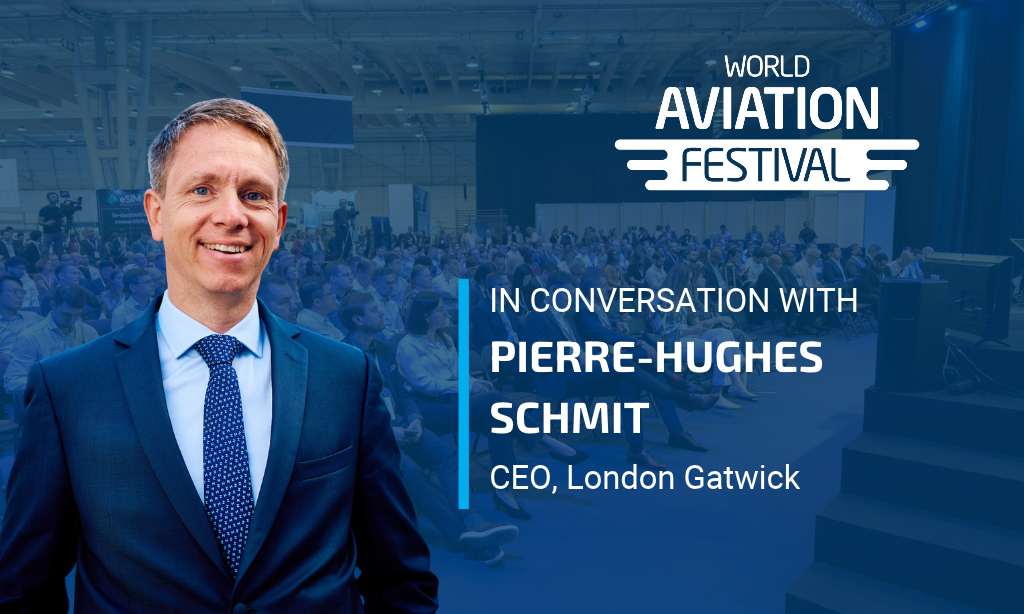
Five airports serve the communities in and around London, making it one of the world’s most competitive aviation markets. West of the city looms the megahub of Heathrow, still one of the busiest airports in the globe, while in the north Luton and Stansted have grown into low-cost hubs, and in the east London City services an elite stream of business travellers.
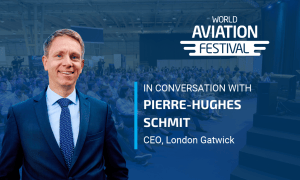
To the south, Gatwick is currently London’s second-busiest airport, transporting 43 million passengers every year. Against its rivals, the airport’s CEO, Pierre-Hughes Schmit, believes his organisation has an edge on affordability when appealing to both airlines and passengers.
The airlines want to control their cost, and we are on-message around affordability. We have a way to operate our airport that is extremely efficient so we can pass on the right cost to the airline.
Gatwick is now the biggest single-runway airport operation in the world, although the construction of a second was approved by the UK government earlier this year. As the airport waits for this significant expansion project to get underway, Schmit is well-aware that airlines will only choose Gatwick if they see potential for capacity expansion. To keep driving growth, the airport has pushed the limit to 57 movements an hour on the runway, facilitated through innovations on the airfield and in the terminals.
We are allocating this additional capacity to commercial capacity, but also equally to resilience, because we’re mindful that today’s operation is extremely dense. When something goes wrong, the whole day is problematic.
Eight airlines have joined Gatwick so far in 2026, including Air France and Air Arabia. The airport has made room for these carriers by investing in air traffic control, including a new AI-assisted solution to maximise use of the runway. Efficiency boosts have also been achieved on the turnaround, with automated bridges, guidance, and gate systems to ensure effective management of passengers passing in and out of planes. Additionally, Schmit hopes to expand the deployment of camera systems, currently operational on certain piers, that provide full computer vision of movements around the gates.
When tech can help, we deploy it progressively in an orderly fashion. We control, we learn, and then we progress little by little on our parameters.
As well as efficiency, resilience is a key priority for Schmit. Existing processes were put to the test earlier this summer when a failure at NATS, the UK’s air traffic control provider, resulted in widespread disruption affecting thousands of travellers. A collaborative decision-making platform helped the airport respond to the event and ensure the knock-on impact was minimal.
However, other incidents are less simple to manage through innovation, such as the water loss that affected the airport in August. Here, Schmit sees tech as an enabler of effective communications. On their phones, airport agents can access real-time updates on everything from functioning escalators to flight times so they are properly equipped to support passengers. Still, he acknowledges that tech is not a silver bullet:
Scenario by scenario, we anticipate. And so for each of them, sometimes the solution is some old fashion hardware, sometimes it’s a process, and sometimes it’s technology.
🎥 Watch the video to get the full interview with Pierre-Hughes Schmit.
Questions asked include:
- With four other airports also serving London, how are you trying to make Gatwick stand out?
- While you wait for Gatwick’s expansion project to become operational, how are you looking to make the most of the infrastructure you already have and keep customer service standards high?
- Which technologies are you investing in to make Gatwick a more seamless and intuitive airport?
- What projects do you have your eye on next to keep Gatwick ahead of the curve and build an airport resilient to future challenges?
Join us at Aviation Festival Asia 2027.
For more like this, see: