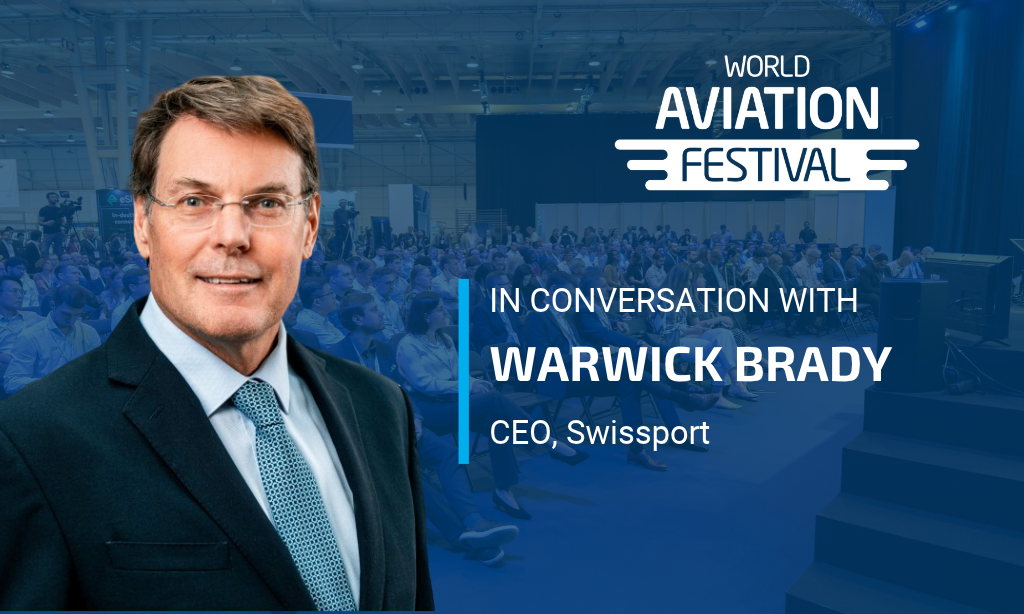
Swissport are the largest ground handling company in the world, loading bags and servicing aircraft at more than 300 airports. The pressure to deliver is high, especially in 2026 where the organisation has had to deal with severe bouts of disruption across the Middle East and beyond.
Serving as CEO for over five years now, Warwick Brady argues that the company is the ‘backbone’ of the aviation industry. With the goal of continually improving service even in a environment where IROPs events are more frequent, Brady puts operational excellence as Swissport’s key strategic pillar.
The better you operate during disruption, the more customers are happy.
To deliver on this aim, a partnership with Swiss hospitality school EHL helps ensure staff are properly trained to meet every situation. Meanwhile, tech investment continues apace through Swissport Labs, the company’s innovation arm. The lab has developed several novel solutions, such as TurnSmart, which uses data to cut turnarounds by two to three minutes. Brady notes that sci-fi robotic concepts are closer to launching at airports than ever:
We’re even trialling innovative technology like humanoids to do repetitive tasks. We’ve also got some trials in Zurich for autonomous vehicles. So, there’s lots going on in our business to make it more efficient.
Working with Shanghai Pudong and China Eastern, Swissport have deployed 93 autonomous vehicles to support the airport as it seeks to become the biggest cargo hub in the world. Brady says the investment has made the warehouse ‘the most advanced in the world’:
Autonomous vehicles are going to have a big impact on reducing incidents and being more efficient. We’ve got 100 drivers in Zurich. By deploying autonomous vehicles, I could take those skilled drivers and put them onto managing projects while all repetitive tasks are done by automation.
Alongside technology his disruption-heavy year has emphasised yet again the importance of closing gaps between airlines, airports, and ground handlers to deliver a more effective service. With Swissport managing more complex global hubs than their competitors, Brady thinks the company is uniquely placed to identify and close gaps in collaborative operations:
Airlines really need to work with service partners like us to get the airports to engage in providing information, not to charge for it. We’re talking to a lot of airports. We know what good looks like.
🎥 Watch the video to get the full interview with Warwick Brady.
Questions asked include:
- With all the disruption across aviation operations this year, there’s been a lot of talk of reframing IROPs as opportunities for good customer service. With that in mind, have you made any leaps forward this year?
- Where do you think there are still big gaps in collaboration between airlines, airports, and ground handlers?
- Where are you seeing the most return on investment from technology at the moment?
- How are you looking to advance service at Swissport in the future? Where will your next investments be?
Join us at Aviation Festival Asia 2027.
For more interviews from World Aviation Festival, see: