
A blog by Paul van Alfen, Senior Advisor Payments at Travel in Motion
One of my takeaways from attending last month’s World Aviation Festival and IATA World Financial Symposium is that airlines are starting to better understand that payments are an important driver of sales and conversion, not just a (high) cost.
For airlines, finding a balance and not operating in isolation is the way forward. It is all about the value exchange between the (corporate) customer on one side and the airline on the other. The same applies to agency-airline relationships, where I see a new focus on creating a win-win situation instead of a zero-sum game.
But let us zoom in on the topic of payments for Modern Airline Retailing (MAR).
Modern Airline Retailing, Offer Order Settle Deliver, 100% Offers and Orders, New Distribution Capability (NDC), ONE Order, Settlement with Orders, Order Management System (OMS) and Delivery Management System (DMS). When it comes to the payment component of MAR, can you “see the wood for the trees”?
Many white papers have been written about MAR, but when it comes to payments, there is no clear, easy-to-digest description available of the end-to-end flow and the factors that will play a role in the transition.
Similar to what happened with NDC, payments seem to be an afterthought and are at risk of being “retrofitted” again. We should not make that mistake again.
This is understandable in a way, as the current version of the International Air Transport Association’s (IATA) “Modern Airline Retailing Reference Business Architecture” includes some 70 boxes. However, only one of them relates to payments (orchestration)!
To help close the knowledge gap for stakeholders in the wider airline payments ecosystem, I started drafting the infographic below, which can be used as a “cheat sheet”. Hopefully, this will help drive discussions across the payments value chain on how to address the future impact of MAR on payment processes.
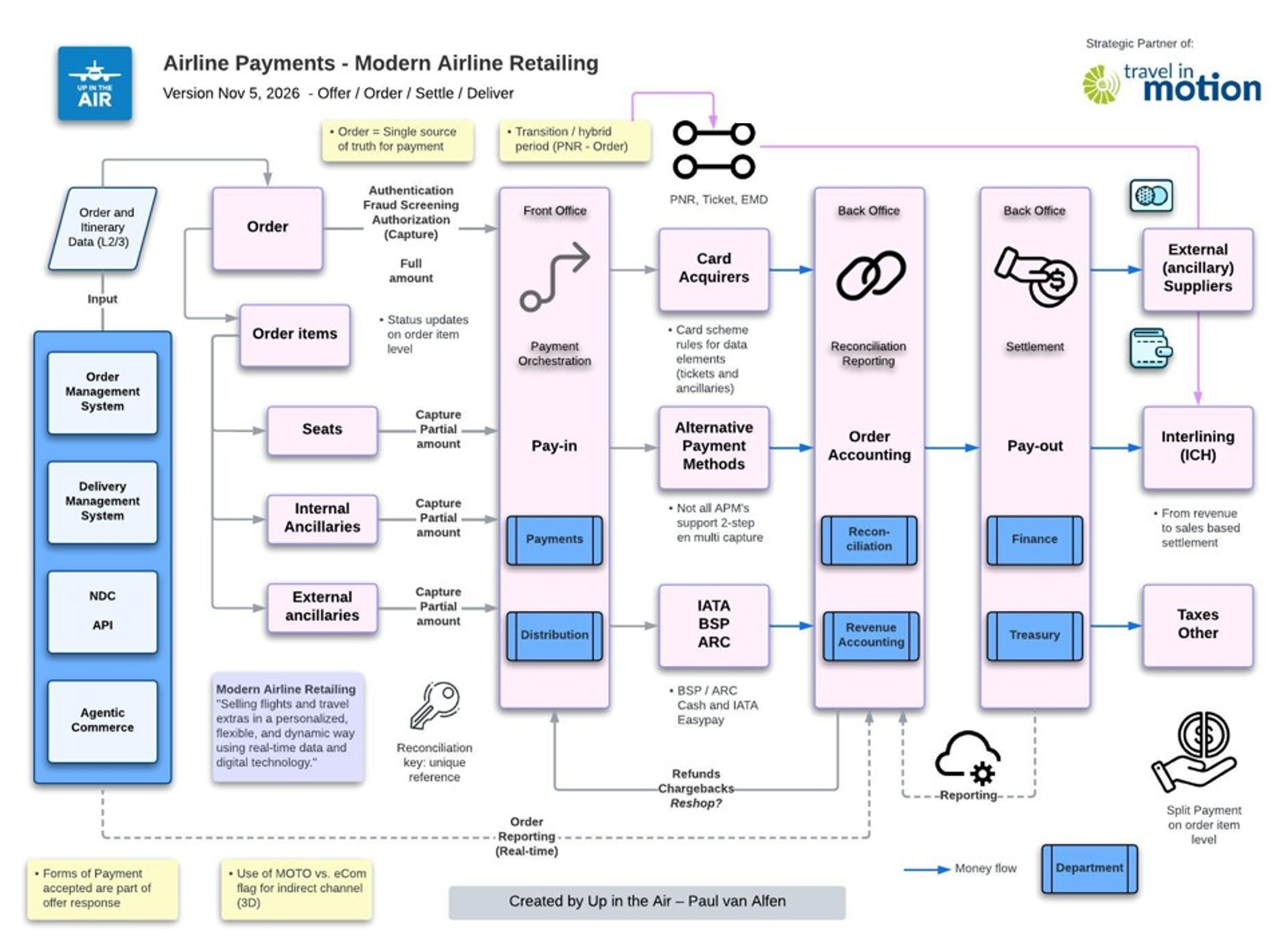
The idea of the infographic is not for it to be fully self-explanatory or to cover all use cases and exceptions. It is a high-level summary to get the thought process going.
Let us walk through it.
First of all, it will be essential for stakeholders from the front office to the back office to be fully aligned, as the new process will have to work end to end from day one (from left to right on the infographic and back). This covers everything from presenting the available forms of payment in the offer response to settlement, reconciliation, reporting and refunds, across channels and payment touchpoints.
As an airline, you will therefore have to ask yourself: Is your current payment architecture future-proof and based on a solid foundation? How are you organised around payments? Do you have dedicated and knowledgeable resources in place to contribute to the transition? Are your current payment partners well positioned to support you during your journey?
What will change over time from a payment processing perspective? To highlight a common misunderstanding, it is important to realise that, for airlines, order management covers both direct and indirect channels, not just NDC! Zooming out and putting in place a holistic payment strategy will therefore be key.
Online retailers and marketplaces worldwide have been using orders since the start of e-commerce in the late 1990s. From a payment processing perspective, the switch from Passenger Name Records (PNRs) to orders therefore does not introduce new steps in the payment flow (think, e.g., single authorisation and multiple capture) as such.
What does change is the underlying data. In particular, ticket and Electronic Miscellaneous Document (EMD) numbers are included in the settlement files for card payments. These references are transferred as part of the data exchange between the acquirer, scheme, issuer and corporate cardholder. These fields will be replaced by order items, and downstream systems will need to adapt to receive both formats during the transition.
Another complexity to consider is the orchestration of split pay-ins (when routing payments to an external supplier for processing) and real-time (split) pay-outs (when the airline is the merchant of record and receives a single pay-in that needs to be disbursed).
Regarding the latter, when airlines want to become true retailers and compete with the likes of travel agents, tour operators and super apps, they should start focusing on streamlining settlement with their ancillary product suppliers. They should start thinking and operating like e-commerce platforms and consider adopting virtual cards as payment rails for business-to-business (B2B) payments.
Another aspect not to be underestimated is that taking control of payments in a MAR scenario means assuming responsibility and liability, as well as absorbing direct and indirect costs, such as investments in payment architecture, fraud risk and foreign exchange (FX) management.
When it comes to planning for a future payment architecture, it is fair to say that a shiny front end will need a robust and agile back end. Order accounting and reconciliation will therefore be essential. Taking a holistic view and making it work end to end, from day one, will be crucial for a successful transition.