The aviation industry manages one of its highest costs with some of its most analogue information. From the pilot’s order to the final load, fuel is measured, moved, and signed for many times before it reaches a wing, tracked manually at each stage, opening gaps between real-time action and final reconciliation.
That gap is getting more expensive. Fuel is the biggest variable cost most airlines carry, about a quarter of operating costs and nearing $252 billion in 2026 alone (IATA). As emissions targets tighten and alternative fuels scale, regulators increasingly require verifiable fuel and emissions data, not estimates. To stay competitive, airlines need faster, more accurate fuelling, which makes digitising the fuel chain central to protecting margin, schedule, and compliance at once.
Where the value leaks
Fuel passes through many hands: refinery, storage, logistics, into-plane operator, airline. Each keeps its own record, in its own format, on its own timeline, almost always tracked by hand. Every manual data entry is a risk, causing up to 3% fuel discrepancy errors a year, according to i6 Group, a leader in fuel digitalisation.
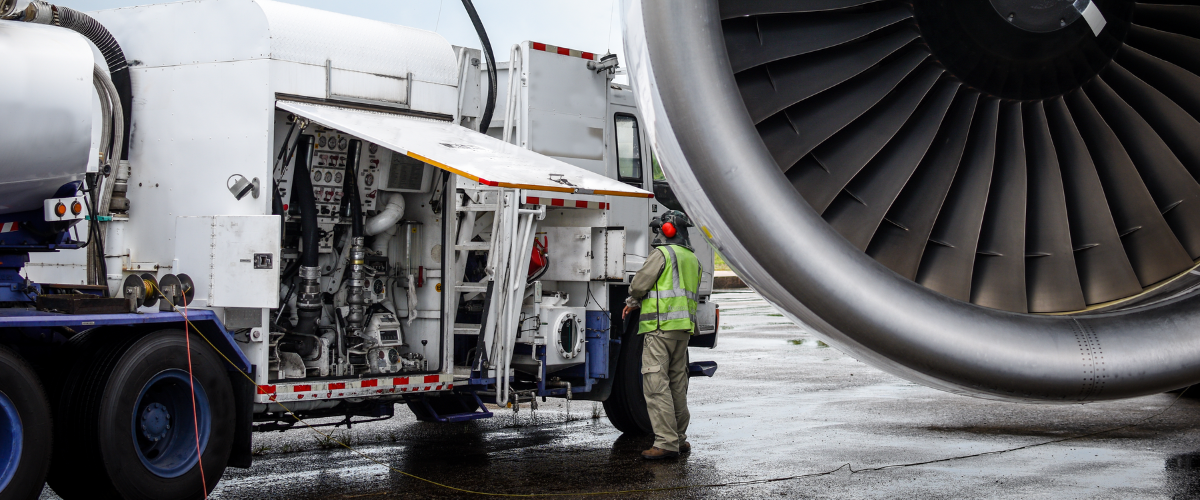
At the farm, value escapes through variance, evaporation, meter drift, and through reconciliation that catches problems only after they happen. A fuel farm moving 10 million litres a day at 0.15% error loses 15,000 litres, roughly $3 million a year at recent fuel prices. At the wing, the loss is the last analogue stage: paper tickets carried around the aircraft, a refueller and pilot walking the flight deck to agree on one number, a re-key into a spreadsheet after departure.
“That created an interrupted workflow. It added extra steps, broke concentration, and slowed down the overall turnaround process.”
Steven Fitzgerald, Director of Sustainability and Finance, Ryanair. Read more at i6.io.
Digitising any single step helps reduce errors and increase efficiency. Connecting the whole chain on one platform is a systems change that stops value from leaking.
Digitising the fuel farm
Digitising the fuel farm turns reconciliation from a monthly cleanup into real-time control. According to data from i6 deployments, reconciliation efficiency and inventory accuracy each rise about 90%, inventory errors fall about 90%, and the resources needed to run the farm drop by roughly half. Fingal Aviation used this approach across Ireland’s international airports, replacing a manual reporting scramble with an automated audit trail.
Digitising into-plane
At the aircraft, the into-plane management platform integrates live airline flight information, managing the whole fuelling operation in real time and removing the paper ticket. Operators allocate trucks and crews dynamically and put the right refueller at the right aircraft. The digital pilot-refueller handshake, where the order is placed, delivered, and accepted without paper, is one part of that platform.
EUROCONTROL puts the network average cost of delay at about €100 a minute, meaning the digitalisation gains show up in the turn. At Menzies, real-time data and better allocation cut fuelling delays by 47% and lifted fuel efficiency by 35%. At North Air in Manchester, real-time flight integration and automatic self-allocation replaced dispatching that could run up to 40 minutes late and cut delays by 92%. Ryanair, working to a 25-minute turn, now runs more than 30,000 flights a month through digital sign-offs and saves 5 to 10 minutes a flight.
Accurate fuel data capture fixes the bill, too, as recording the exact volume at delivery makes the invoice right the first time. At EPPCO, the largest into-plane operator at Dubai International, digital capture eliminated invoicing errors.
One chain, connected
Connecting the whole fuel supply chain delivers more value than digitising any single stage. When farm and wing records sit in separate systems, someone reconciles them manually and the friction remains. One platform removes it: when the data exists as a single record, the supplier delivers the exact volume, the airline sees status live, and the auditor gets the report on demand, one version of every figure instead of three.
Every stakeholder benefits. Into-plane operators save the most visible time, with fuel-farm integration and a paperless airline link driving quicker turnarounds, less overfuelling, and cleaner invoicing. Fuel farms gain live inventory control, with data arriving automatically, shortage alerts, and daily oversight of stock and waste. Airlines and suppliers get frictionless ordering and more transparency through digital sign-off from the cockpit, self-serve reporting, and dispute-free invoicing.
Sustainability
The same connected record that settles an invoice also turns an emissions claim into fact. A digital chain tracks multiple fuel types, SAF included, and ties the data to a specific uplift, instead of a monthly average. The EU’s ReFuelEU Aviation mandate now requires SAF to reach at least 2% of fuel at EU airports in 2025, rising to 6% by 2030, 20% by 2035, and 70% by 2050 (European Commission). Meeting those thresholds is one task; proving it, flight by flight, is another that paper cannot manage. Better tracking does not decarbonise a flight on its own, but it does cut waste. At London Heathrow, digitising British Airways’ refuelling improved optimisation by more than 50% and saved around 2,000 tonnes of fuel and roughly 6,000 tonnes of CO2.
“With i6 technology, we benefit from efficiencies in every flight. That includes making sure the aircraft has the optimal amount of fuel saving on direct fuel costs and minimising extra weight.”
Captain Spencer Norton, Flight Efficiency and Evaluation Manager, British Airways. Read more at i6.io.
Deployed and proven
Fuel digitisation technology is proven and in daily use across fuel farms, ramps, and airlines. Operators still working the chain by hand pay for it every day in incorrect loads, missed minutes, and disputed bills. The ones pulling ahead connect the whole chain on one platform, so the fuel and its data finally move as one. Digitising is no longer a question of if, only when.
“It gives us a clear picture of what is happening across the airport in real time, and we can share that with our customers the moment they need it.”
Hosam Khayat, Chief Commercial Officer, United Fuel Company. Read more at i6.io.
About i6
i6 digitises aviation fuel management across the supply chain, from the fuel farm to the wing, and our technology is in daily use at more than 300 airports in 40-plus countries. Join us alongside Ryanair at World Aviation Festival 2026 (Lisbon, 13 to 15 October) and book a short meeting here to see the impact it would have for your team.
For more information, please visit www.i6.io.