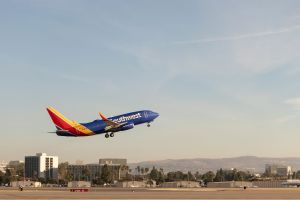
The Climate Change Committee warns that plans to add a third runway at London Heathrow airport can only go ahead if airlines pay for the removal of carbon dioxide from the atmosphere.
The UK’s biggest airport, and the second-busiest airport worldwide, Heathrow currently operates only two runways. Advocates for the third runway scheme argue the airport needs a third to meet rising demand for air travel, as well as keeping the British aviation industry competitive.
But research suggests that an expanded Heathrow would emit the same volumes of CO2 as 5 million homes. And now, the Climate Change Committee, which advises the UK government on climate issues, has published a report asserting the only way a bigger Heathrow can be made sustainable is by getting airlines to pay for their pollution.
The report recommends that airlines rapidly scale their use of sustainable aviation fuel (SAF), and pay for the removal and storage of the extra carbon emitted into the atmosphere.
Nigel Topping, the chair of the committee, said:
The government cannot expand Heathrow airport without requiring the aviation industry to clean up its emissions. Therefore, the government should legislate policies that require the aviation industry to fully address all of their emissions by 2050, either directly or by purchasing engineered removals. The polluter-pays principle must apply.
The report says such a policy would over 25 years increase short-haul ticket prices by around £150, and transatlantic flights to New York by up to £400. Tim Alderslade, chief of industry body Airlines UK, argued these proposals would make travel unaffordable for millions. He instead suggests the answer to more sustainable aviation lies in affordable SAF, airspace reform, and scaled-up carbon removals.
Meanwhile, critics say the report’s suppositions rely on technologies that are not yet widely tested, including SAF and carbon capture, and do not provide adequate guardrails for the UK to meet net zero targets.
A spokesperson for Heathrow said:
Heathrow expansion cannot be a choice between economic growth and net zero – it must deliver both. The CCC’s assessment does not change this and acknowledges that the key solutions exist today. We will continue working with government and partners across the aviation sector to ramp up today’s proven technologies, while examining options for how the billions of pounds passengers already pay in carbon taxes can be used to support this.
Elsewhere in Europe, the EU’s attempts to bring aviation’s emissions in line with net zero targets are relying on scaled SAF mandates. Airlines have criticised this approach as it places a significant cost burden on an industry that already struggles on fine margins. Heathrow have already raised their SAF mandate above that stipulated by the UK government to 5.6%.
The UK government are set to make a decision on whether or not Heathrow should expand later this autumn.
Join us at World Aviation Festival 2026 to discuss advancing sustainability within aviation.
For more like this, see: