The dominance of social media has added a whole new rulebook to the marketing game. In this medium, customers expect all content to be personalised to them, while humour and authentic language are increasingly expected even from global brands.
In the aviation world, Ryanair’s cheeky tweets and memes have helped solidify its brand identity and connect the airline to new customers. But Icelandair have elevated the game again, with two viral social campaigns earning the carrier a reputation for offbeat humour as well as cutting-edge marketers.
In the past year, the carrier’s ‘Is it real?’ video campaign earned 7.4 million views on YouTube alone. The short film pokes fun at a man who claims Iceland’s landscapes can’t be real and must be AI-generated. Icelandair’s marketing team riffed on the country’s natural landscapes again in their ‘Really Bad Photographer’ job advert. Posted across social media, the mock-newspaper ad attracted more than 127,000 applicants. And one successful candidate was actually sent to Iceland on a photography holiday to prove that the country is so beautiful anyone can take a good picture there.
These campaigns are the brainchild of Gísli Brynjolfsson and his team at Icelandair. But Brynjolfsson says achieving this success on social media is difficult because airlines aren’t just facing competition from other carriers. Rather, Icelandair must battle for attention with the millions of other content sources and marketing campaigns appearing on users’ feeds.
The biggest challenge today is just getting attention. You can’t just put out another destination with a price, that’s not going to cut it. You have to be way more interesting.
A modern philosophy for airline marketing
Creating a distinctive brand that builds an emotional connection with Icelandair’s audience is at the core of Brynjolfsson’s philosophy. The ‘Is it real?’ video campaign has been especially successful because Icelandair were able to tap into anxieties around AI-generated material, and the veracity of digital content, in a tongue-in-cheek way. Indeed, the impetus for the campaign came after the team posted photos on Facebook of volcanic eruptions beneath the Northern Lights on the Reykjanes Peninsula. When users in the comments began to debate if the pictures were real or not, Brynjolfsson says he knew the issue had to be addressed.
There’s too much fake, AI-generated content, and people are just becoming tired of it. I think that they’re really craving something authentic, something that’s genuinely real, and we felt that this was a very natural space for Icelandair to play in.
Not only did the campaign play nicely into contemporary debates about AI, it also stressed the otherworldly beauty of Iceland’s unique natural landscapes. Emphasising the splendour of the island was also the principle behind the Really Bad Photographer job advert. 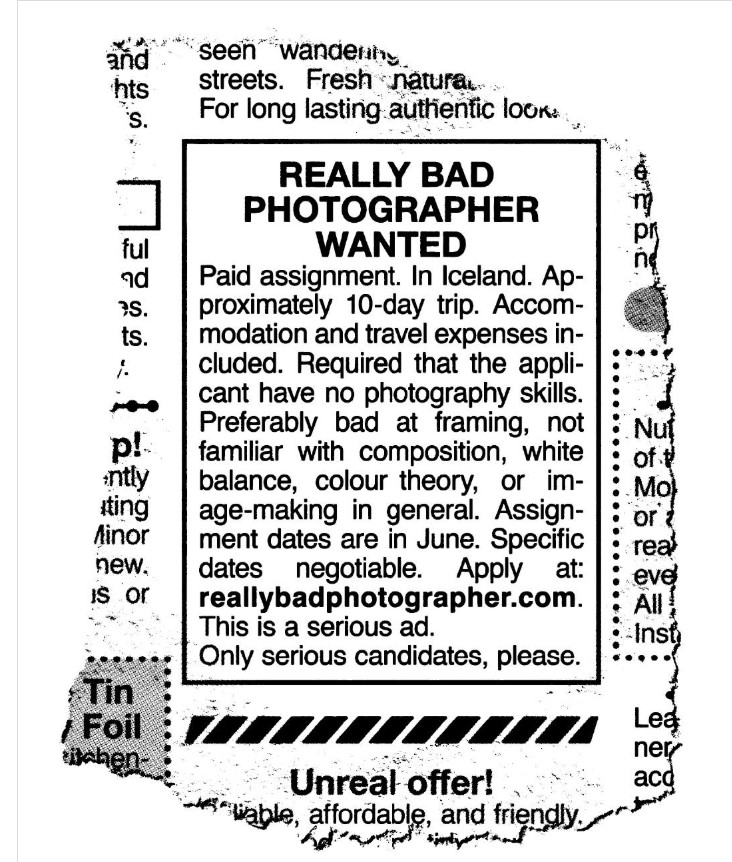
After whittling down the applicants, Icelandair picked 28-year-old Blanche to go on an all-expenses paid trip across the country. Her photo diary was published online, while a temporary exhibition of her work launches in London next week. Only the raw files of her 5,000-plus images will be on display to demonstrate that Iceland needs no editing, and definitely no AI.

One of Blanche’s raw, unedited images of Iceland that will go on display at White Rabbit Studios, Shoreditch.
New rules for marketing success
Brynjolfsson says the Really Bad Photographer advert was picked up by more than 1,500 media outlets worldwide, and the campaign’s success also translated into organic growth across social platforms and newsletter subscribers. The ad and the ‘Is it real?’ video helped foster a stronger brand identity for Icelandair, while simultaneously promoting Iceland as a bucket-list tourist destination
Quite often people talk about brand and performance as if they’re opposite. But we truly believe that like a strong brand makes the performance just work a bit harder.
An area of increasing debate among marketing professionals is generative AI, and how brands are showing up in large-language models such as ChatGPT. In the travel world, it’s unclear as of yet how many passengers are using AI to plan trips. Some surveys suggest as high a proportion as 90%, others as low a 8%.
Although Brynjolfsson is interested to explore these behaviours further, he says his team’s goal is to make Icelandair at the forefront of customers’ minds even before they try AI search.
Branding has never ever been as important as it is today, because obviously those AI tools and what’s happening behind them, at least on our side no one understands how how it works and how it will develop. I think that just going back to the basics and truly believing that the brand is the strongest thing that you can have in your toolkit is very relevant at the moment.
Icelandair’s successful campaigns have demonstrated these principles in action, delivering global engagement and getting people excited about the brand in ways that technology cannot. Brynjolfsson will be sharing more about Icelandair’s strategy and his plans for the future at World Aviation Festival 2026’s Marketing Summit. Don’t miss the opportunity to get exclusive insight from Brynjolffson and the full panel of industry marketing experts:
- Benedikt Siewele, CMO, SunExpress
- Karime Makhlouf, CCO, Royal Jordanian Airlines
- Maria McKinnon, Director, Brand and Marketing, oneworld
- Gísli Brynjolfsson, Director Global Marketing, IcelandAir
- Christina O’Rourke, Director of Creative Strategy & Content, United
🎥 Watch the video to get the full interview with Gísli Brynjolfsson.
Questions asked include:
- How are we seeing aviation marketing evolve in the new digital media landscape? What’s the philosophy driving Icelandair’s strategy at the moment?
- Icelandair went viral twice in the past year with your ‘This Is Not AI’ video campaign as well as the Really Bad Photographer job advert. How did these campaigns come about and what success have you seen as a result?
- How are you using technology to identify potential customers and make sure your brand reaches the people most likely to engage?
For more like this, see: