Responsive, intelligent movement reduces disruption and sustains growth
Aviation leaders face fluctuating passenger volumes, operational complexity, supply chain constraints, rising costs and sustainability pressures. Flight delays and congestion remain persistent as passenger volumes grow faster than physical infrastructure and network capacity. IATA’s 2026 outlook projects 5.2 billion passengers in 2026, industry revenues of $1.053 trillion and a net profit margin of 3.9%.
Record demand alongside steady profitability creates a tension: aviation is growing, but the cost of small failures is rising. In a highly interconnected ecosystem, operational inefficiencies in one area quickly affect another.
Where aviation operations are feeling the pressure of growth
Pressure is visible across multiple operational touchpoints:
- Aircraft turnaround: Assaia’s 2025 Turnaround Benchmark Report analysed more than 450,000 turnarounds, finding a 25% reduction in median departure delays and a 5% increase in turnarounds per stand. Better-managed turnarounds can free capacity without new infrastructure.
- Workforce sustainability: Boeing’s 2025–2044 Pilot and Technician Outlook estimates that commercial aviation will need 660,000 new pilots, 710,000 maintenance technicians and one million cabin crew members over 20 years.
- Baggage performance and cost: SITA’s 2026 Baggage IT Insights report says the mishandling rate fell 23% to 4.9 bags per 1,000 passengers in 2025, yet mishandled baggage still costs the industry an estimated $6.3 billion annually.
- Ageing fleets and MRO: Oliver Wyman’s 2026–2036 Global Fleet and MRO Market Forecast reports about 17,000 unfilled aircraft orders, a backlog exceeding 12 years at current production rates. Longer service lives raise the need to anticipate failures, prioritise maintenance and reduce disruption.
Physical AI drives productivity in large-scale, high-mobility environments
In safety-centric airports, a growing queue, delayed turnaround step or baggage belt slowdown can cascade into wider disruption. On-the-scene intelligence from autonomous devices and machines helps avoid a crisis through proactive attention.
Autonomous vehicles, robots and AI-assisted ground equipment provide support beyond just movement, but they need coordinated operational intelligence, not navigation alone. HCLTech is helping aviation leverage Physical AI and autonomous devices for a closed-loop intelligence layer that:
- Detects meaningful change
- Understands its operational impact
- Triggers the right response
For high-volume, high-activity environments like aviation, shipping and logistics, a multimodal, edge-to-cloud Physical AI platform complemented by intelligent edge and connected data capabilities gets disruption under control.
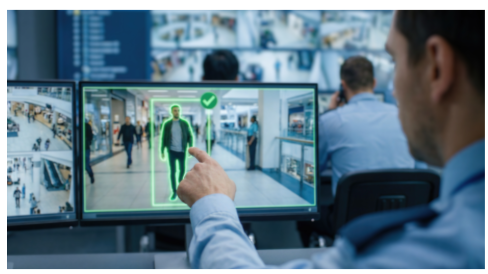
HCLTech VisionX is an enterprise-grade, edge-to-cloud AI platform for converting video, images and sensor data into real-time operational intelligence. It ingests real-time visual feeds, LiDAR, telemetry, and sensor data to automate monitoring, hazard detection, and asset tracking.
With Physical AI capabilities like these, machines, vehicles and robots perceive, reason and act autonomously in the physical world. In airports, an autonomous AI solution combines monitoring, predictive analytics and automated workflows to improve resilience and efficiency. This translates to capabilities like ground equipment orchestration, automated safety inspections, passenger flow tracking, and syncing real-world operations to digital twins.
Real-world input maps to digital twin for proactive analysis
The Physical AI approach blends real-time perception with an operational digital twin. Signals from cameras, sensors, LiDAR, telemetry and PLC data reveal deviations and trigger updates, alerts, predictions or control actions.
By combining AI, edge computing and IoT, Physical AI helps airport systems predict movement and support autonomous action. Open architecture enables interoperability across engineering systems, operational technology, IoT platforms and AI applications, allowing airports to evolve digital twins without locking into one technology stack.
Autonomous airports and ground support orchestration
Closed-loop detection can connect terminal flow, security, baggage, apron movement and facility systems. Physical-reality-to-digital-twin loops can detect drift, validate events, simulate responses and support safe autonomous operations in real time.
Airports are exploring autonomous baggage carts, ramp and cleaning robots, AI-assisted routing and integrated airport operations centres to improve throughput and reduce manual coordination.
How to build a practical plan for Physical AI
A practical plan starts with measurable operational challenges, validates value through pilots and scales capabilities that improve safety, efficiency, passenger experience and resilience. To learn more about how agentic AI enables intelligent automation with the right security, governance and ethical foundations, explore the white paper, “Agentic AI for intelligent automation.”